VOLUME 1
ca. 53 min. - Newsreel 459 (21 June 1939), Archival footage from 1919 shows
German Imperial Navy en route to scuttling at Scapa Flow, 20 years later, reborn
German fleet displays readiness on high seas. Two submarines, American and British,
are crippled in separate accidents at sea. At a French air show, a Fokker Jungmeister
and its daredevil French pilot stage acrobatic stunts. In Rome, 20,000 sailors
march before King Emmanuel and Mussolini. German gymnasts stage an "impressive
display" of physical training for military and diplomatic dignitaries.
A cultural festival in mostly German Danzig becomes a major protest rally as
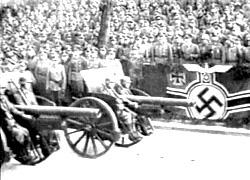
Goebbels addresses a huge crowd. German troops stage artillery exercises to
impress visiting Spanish officers. Scenes from Greater Germany Bicycle Race
show cyclists crossing from Austria to Bavaria. Highlights from 1939 German
soccer championship final played in Berlin's Olympic Stadium. 18 min. Newsreel
468 (23 August 1939), Westphalian Hitler Youth and League of German Maritime
Prestige on Danube cruise to Budapest. In Turin, Italian maneuvers end with
parade of troops and mechanized divisions before Emperor and King. A trick-photography
map sequence, creation of Poland from parts of Germany, Russia, and Austria-Hungary.
The free city of Danzig, here, according to the film Poles have usurped certain
rights of sovereignty. The film explains that this ancient German city is being
methodically made Polish. In the streets hang banners reading "We want
to return to the Reich." A massive Polish ammunition dump at Danzig Harbor
entrance, expansion of Polish port Gdynia to divert traffic from Danzig and
strangle it there, ethnic Germans flee Poland, refugees are interviewed, tales
of Polish oppression and violence. Newspaper headlines, German and Soviet governments
agree to mutual non-aggression pact, Foreign Minister von Ribbentrop boards
plane to Moscow to conclude negotiations. 14 min. Newsreel 470 (7 September
1939), In Danzig, civilian men fortify border against Polish intervention, SA
militiaman shot by Poles is buried. Ethnic Germans flee Poland as farms and
homes are methodically plundered and burned. A man standing before his wrecked
house tells in synchronous sound how Polish planes bombed it at night. In Danzig,
after independence is declared, a German militia unit attacks the Polish post
office. German troops enter Danzig. Civil air-defense measures mechanized and
cavalry units cross the border despite resistance, a sortie from an airfield
at dawn, air and sea bombardment of the Westerplatte in Danzig. Columns of German
tanks and infantry move deep into Poland, finding the burning houses of ethnic
Germans and bombed bridges, the Vistula bridge at Tczew has been fully destroyed.
Engineers repair bridges and German tanks cross. Ethnic Germans welcome advancing
troops. 21 min.
Order # CH 801 $29.95
VOLUME 2
ca. 55 min. - Newsreel 471 (14 September 1939), At Berlin's Rheinmetall Borsig
Works field Marshal Hermann Goering enjoins a crowd of factory workers to display
their loyalty to the Fuehrer. German infantry advances ever deeper into Poland,
troops round up civilian prisoners, including Polish Jews, and insurgents are
taken to large camps. Footage shows worshipping German soldiers exiting the
Jasna Gora Church, belying Allied claims that Germans had destroyed it. German
tanks cross bridges repaired by combat engineers. Stukas deliver long rolls
of surveillance film which are developed and studied in the field. Hitler reviews
maps in his field headquarters, then drives to front to review troops. the Wehrmacht
crosses the Vistula. Columns of captured Polish troops march by the camera,
Polish prisoners describe conditions in Poland and their reluctance to fight
in war. Wehrmacht and National Socialist People's Welfare Organization feed
refugees. Ethnic Germans greet advancing German troops. 18 min. Newsreel 472
(20 September 1939), Women replace men called to the front as the first casualty
train arrives, work in munitions plant, Luftwaffe planes based at a captured
Polish airfield practice strafing while German troops buy crew of a downed French
plane with military honors in the west. In Krakow, the Wehrmacht honors the
memory of Poland's Marshal Pilsudski. Sequence shows captured Polish soldiers
at a POW camp, a RAF officer describes his decent treatment by the Germans.
Ethnic German victims of Polish violence identify their oppressions to Wehrmacht
troops while others return to their burned homes. A destroyed village with an
undamaged synagogue is shown, then Jews in the ghettos of captured cities in
concentration camps and a forced labor. Tank columns push forward, enter Lodz
and are met by crowds of ethnic Germans. The Fuehrer flies to the front to be
briefed by Field Marshal Goering and General von Brauchitsch, drives to Lodz,
review troops as they cross the San River. 19 1/2 min. Public Service Announcement,
about boarding, 1 min. Newsreel 473 (27 September 1939), The third week of the
war with Poland, information on pockets of resistance is radioed to an airfield
from a reconnaissance plane, Stukas and bombers take off, bombing bridges to
block the retreating Polish army, bombed rail yards and destroyed trains are
seen from the air, House-to-house combat in captured cities, snipers are countered
by leveling entire houses. Truck columns speed penetration deep into Poland.
Tanks roll over every hindrance as infantry units cover 50 to 60 kilometers
a day. Mail is sorted in field by an army of officials, then delivered by motorcycle,
soldiers read about the war in the papers while they march. A Polish armored-fortress
train has been destroyed by Stukas. Foreign military attaches view blown-up
trains and rail lines, captured arms. On the 18the day of hostilities, the Wehrmacht
High command declares an end to Polish campaign. German and Soviet units meet
at Brest-Litovsk, draw tentative demarcation line. German and Soviet commanders
jointly inspect troops passing in review. Gdynia, a surviving Polish position,
is bombarded from land and sea, Hitler tours city, then enters Danzig, where
his motorcade is cheered by crowds in swastika-bedecked streets. 16 1/2 min.
Order # CH 802 $29.95
 VOLUME
3
VOLUME
3
ca. 51 min. - Public Service Announcement, Featuring Tran and Helle, on blacking
out lights. b&w, 1 min. Newsreel 474 (4 October 1939), In Berlin, General
von Brauchitsch and Field Marshals von Mackensen and Goering preside over the
military funeral of General von Fritsch, slain near Warsaw. Foreign Minister
von Ribbentrop flies to Moscow to finalize the Russian-German alliance and the
partition of Poland, a map shows the demarcation line. Hitler Youth practice
putting out air-raid fires, help dig root crops, whole the German girls League
brings flowers to wounded soldiers. In agriculture, as in sports, it's 'business
as usual'. Occupation authorities in Poland use forced labor to deal with 'the
Jewish issue'. Hitler observes bombardment of Warsaw by air attack and artillery
barrage shortly before the Polish surrender, German units enter Warsaw. In Wilhelmshaven
the U-boat crew which sunk the aircraft carrier Courageous is decorated with
the Iron cross, congratulated by Hitler. U-boats and battleships display German
naval might at sea. 16 min. Public Service Announcement, Featuring Tran and
Helle, on underground rumors. b&w, 1 min. Newsreel 477 (25 October 1939),
the leaders of non-aligned nations discuss neutrality, impact of British blockade.
Russia and Japan agree to new demarcation line. In occupied Upper Silesia, German
engineers and managers bring recaptured mines and steel mills on line for military
production, liberated ethnic Germans contribute to the Winter Relief fund for
the first time. Additional emphasis is placed on fitness in Germany. On the
Western Front, troops patrol the West Wall. Japanese general Terauchi tours
the fortifications, declares them "Absolutely impregnable". On the
North Sea, the Kriegsmarine displays its might. Captain Guenther Prien and the
crew of the U-boat that sank two ships in Scapa Flow receive a hero's welcome
in Berlin and are congratulated by Hitler. A request concert is broadcast on
radio by Heinz Goedecke's 'Wunschkonzert' band, as the band performs an airman's
march, "Flyer, Aim High", Luftwaffe squadrons are shown flying in
formation. 16 1/2 min. Public Service Announcement, " Featuring Tran and
Helle, on donating to military hospitals. 1 1/2 min. Newsreel 480 (14 November
1939), the new Japanese Foreign Minister takes office, reaffirming Japan's ties
with Germany despite German-Soviet pact and advising England and the US to respect
the new order in the Far East. Nonetheless, military readiness on the Panama
Canal is heightened. In America, millinery fashions with a military theme are
modeled. In India, riots are staged against British colonial oppression, while
the British press raves about war victories and the Queen visits an empty hospital
train. German soldiers patrol the Western Front, capturing French emplacements.
On the home front, women replace conscripted men in the work force. In occupied
Poland, Reich Minister Frick visits the Koenigshuette steel mill. On November
9th in Munich, the anniversary of the failed Putsch of 1923 is observed, Reich
Minister Rudolf Hess honors the "first martyrs of the National Socialist
Movement" in a stage ceremony. Shortly before Hitler finished his traditional
speech in the Buergerbraeu-Keller on the eve of the ceremonies, a bomb exploded
in a failed assassination attempt. Before the Feldherrnhalle, a state ceremony
for the eight bomb victims is led by Hess. 15 min.
 VOLUME
4
VOLUME
4
ca. 54 1/2 min. - Public Service Announcement, Featuring Tran and Helle, on
trusting the government. b&w, 2 min. Newsreel, 482 (29 November 1939), Japanese
military maneuvers, combat training in the shadows of Mount Fuji. German home
front scenes, drills and target practice for the Hitler Youth (synchronous sound),
government nurseries provide day care for working mothers, state modernization
of hog-raising, young women volunteer for new farm labor camps opened in the
east. Military scenes, the role played by horses, even in a highly mechanized
Wehrmacht, the importance of the army press to soldiers on the front. Inspector-General
Dr. Todt reviews newly-installed military fortifications in the West. At sea,
the continued war against English shipping, searching a Finnish ship for contraband
(one of several hundred such searches during the fall of 1939). Kiel Harbor
scenes, impounded foreign ships. Segment documenting Baltic German resettlement,
aboard ship en route to Germany, a jubilant welcome in Gotenhafen, naturalization
procedures, job placement interviews (synchronous sound) in Posen. A peasant
family from Volhynia, its worldly possessions piled into horse-drawn cart, returns
to the Fatherland, under "the protection of Greater Germany", family
members begin work on their new farm. 16 min. Public Service Announcement, Featuring
Tran and Helle, on clearing away junk and clutter. 2 min. Newsreel 483 (6 December
1939), Sporting events, in Spain, athletic demonstrations signal a new national
spirit, in Japan Hirohito greets his subjects at Japan's annual track festival
(brief martial arts segment). German sport, Zugspitze skiing scenes. German
handicrafts, wood-carvings from Bavarian and Bohemian regions. A massive Red
Cross initiation in Berlin, as 4,000 volunteers swear allegiance to the Fuehrer.
Work scenes, German Labor Front members engage in voluntary labor, in "former
Poland", German salvage crews rebuild damaged bridges. German trade relations,
Romanian peasants busily harvest corn and wheat earmarked for Germany. In contrast,
ranks of idle, hungry men grow in Amsterdam, Oslo, Rotterdam, and Antwerp. At
sea clearing enemy mines with the German Navy. In France, a bid to bolster French
confidence as British infantry march through Paris. With German troops at the
West Wall, drills and maneuvers, a reconnaissance unit infiltrates enemy lines.
Naval segment inside a U-boat as it torpedoes an enemy vessel, intercepts a
cargo ship, and returns to a hero's welcome at Kiel Harbor. Luftwaffe scenes,
reconnaissance flights skirt the English coast, while below, half-sunken ships
announce the success of Germany's war on British shipping. 19 min. Public Service
Announcement, Featuring Tran and Helle, against hoarding precious metals. 1
1/2 min. Newsreel 488 (10 January 1940), Scenes of Britain's forced withdrawal
from Tientsin. Winter scenes, a deep freeze in Rome, snow and sledding in Berlin.
Winter sports, ski-jumping at Garmisch-Partenkirchen, ice-sailing, figure-skating
scenes. Day care in Vienna, in a remote Tyrolian village, volunteers of the
German Girls league perform farm chores. In Posen, a sea of army recruits stands
for review. Industrial scenes, manufacturing bullets, precision forging of artillery
cannon. Military exercises, anti-air defense showcases new weaponry and tactics.
14 min.
 VOLUME
5
VOLUME
5
ca. 49 min. - Newsreel 491 (31 January 1940), the hard winter continues. Holland's
frozen canals spell disaster for shipping, icebreakers in action , an airlift
provisions marooned islanders. German sport, ski instruction for Hitler Youth
from Sudetenland. Herber and Baier, world-champion German pair skaters, perform
for troops. Industrial scenes, new coal liquefaction complex promises thousands
of new jobs, while making Germany 'largely independent of gasoline imports".
On frontier separating German and Russian "spheres of influence",
Russian oil is loaded for shipment to Germany. Resettlement in the East, "the
biggest migration of our era" (map displays). Segment depicts ethnic Germans
from Russia returning the Fatherland, on horse-drawn wagons through biting cold
and snow. Reentry into Greater Germany, huge encampments provide stopovers for
exhausted repatriates. Reich Minister Goebbels tours Western Air Defense Zone,
German engineers build bridge in bitter cold. Naval scenes 90,000 tons of enemy
shipping sunk in 1 week alone, victorious return of an U-boat after long tour
at sea, Admiral Doenitz awards crew the Iron Cross. At sea aboard battleship
in deep winter, crewmen fight in the elements in maintaining the big guns on
deck. 17 min. Newsreel 492 (7 February 1940), Public service announcement, featuring
Tran and Helle, on writing to soldiers at the front. In Japan, German winter
sports in vogue, downhill skiing on Mt. Fuji. International winter games at
Garmisch-Partenkirchen feature ski competitions. Berlin Sports Palace, aspiring
athletes demonstrate gymnastics, weight-lifting, and track skills, German Labor
Front sponsors ambitious new job-training program. Inside a fire station, fire
drill scenes. Commemorating seven years of National Socialist rule, map displays
contrast current "national empire in Europe's heart" to German past
of territorial fragmentation. Western powers aim to dismember Germany anew.,
the Fuehrer responds to the threat, excerpts from Hitler's January 30th address
at Berlin Sports Palace (synchronous sound), central Europe's 80 million Germans
need to "breathe freely", the German imperative for Lebensraum. Foreign
military attaches observe German infantry exercises. The role of engineers in
today's army, assault engineers join infantry in compact on an unnamed front,
flame-throwers provide the margin of victory. Luftwaffe sorties over North Sea,
150.000 tons of cargo sunk over 11 days, segments show 3 separate engagements
with British "pirates' and 'gunrunners', 3 British ships left in flaming
ruins. 18 min. Newsreel 496 (6 March 1940), A devastating fire in Japan leaves
6,000 buildings destroyed , 36,000 homeless. In Barcelona, Franco attends first
annual "liberation" celebrations. In Rome, Mussolini's elite militia
celebrates own anniversary, with the Duce in attendance. president Roosevelt's
special envoy, Sumner Welles, arrives in Italy for talks, then to Berlin, for
talks with Hitler. In Leipzig, a German Wartime Trade Fair is convened, demonstrating
Germany's economic prowess despite all blockade attempts. Goebbels attends,
emphasizes Fair's strategic importance, exhibits feature German toy exports
and precision machine tools. German industrial scenes, inside massive coking
plant, anti-aircraft installations protect Reich's heavy industries in western
Germany. Naval scenes, U-boat and its crew return home victoriously, Rear Admiral
Doenitz on hand with Iron Crosses. Torpedo motorboats patrol the North Sea,
monitoring neutral and enemy shipping. On land, scouting parties probe enemy
defenses (unspecified front). Blitzkrieg formations in combat, the need to better
coordinate Panzer units with infantry is stressed. 14 min.
 VOLUME
6
VOLUME
6
ca. 52 min. - Newsreel 497 (14 March 1940), Public services announcement featuring
Tran and Helle, on donating scrap metal. The hard winter continues, a blizzard
strikes Japan. In Bavarian Alps, rescue team stages an acrobatic high mountain
rescue. At Garmisch-Partenkirchen, a friendly skiing competition between Hitler
Youth and Italian counterparts. Berlin, an ice show for soldiers, with German
champion Lydia Reicht. and world champion team Herber and Baier. More sport,
scenes from first German war-time gymnastics competition held in Berlin (slow
motion segments). Solemn scenes from Memorial Day, on western front, General
von Brauchitsch, Army commander-in-Chief, lays wreaths at gravesides. Major
national observance at Zeighaus in Berlin, attended by Hitler, Goering , Goebbels
and other top leaders speech from Hitler (synchronous sound) calls for "the
greatest victory in German history". another U-boat returns to port, while
at sea, Commander Hartmann and crew sank 45,000 tons of enemy cargo. Near Maginot
Line German army takes its first "Tommy" prisoners of war, capture
and debriefing scenes. Combat segment (unnamed front), heavy artillery and advancing
infantry work closely together to deliver the enemy a "knockout blow".
20 min. Newsreel 499 (28 March 1940), Public service announcement featuring
Tran and Helle on listening to foreign radio. Brenner Pass, Hitler and Mussolini
hold their 5th summit. Massive bridge construction project in Linz (Hitler's
home town). German industry, women take over heavy industrial work, boatyard
scenes feature manufacture and launching of U-boats, factory scenes show Messerschmitt
fighter plane assembly. U-boat crew returns from successful mission, welcomed
by Admiral Erich Raeder. Luftwaffe segment, the Adler Wing returns from bombing
British Home Fleet at Scapa Flow, at home airbase, pilots describe their exploits.
14 1/2 min. Newsreel 502 (17 April 1940), April 9, 1940, Germany invades Denmark
and Norway. Denmark, German forces land at dawn in Copenhagen harbor, Luftwaffe
planes drop leaflets, proclaiming Germany's "friendly occupation",
as civilians begin their morning rounds. German officials meet with Danish representatives,
agreeing to provisional cooperation, Danish troops ordered not to resist, Copenhagen
police "clarify" allegiance to the government and get back their weapons,
British diplomats and enemy agents are rounded up. By noon, Copenhagen scenes
depict a return to "business as usual", meanwhile, ever more German
troops pour in. Across Denmark, German forces take control over communication
and transport lines, soldiers seize strategic bridge linking Jutland and Fyn.
Troops and military supplies stream in from Germany via rail, with utmost speed,
fortifications established along Danish coast. Norway invasion, the seizure
of a coastal airfield, heavily armed assault forces fan out to nearby military
targets, along coast, artillery and machine gun installations quickly put in
place. At Oslo, a nearby fortress offers resistance, heavy bombardment forces
its surrender, allowing German troops to secure Oslo unhindered. On Norway's
western coast, invasion force arrives in Bergen harbor, takes city with little
resistance. With control secured over major ports, German forces move quickly
into Norway's interior, in Oslo, German army holds outdoor band concert for
civilians, minor fraternization scenes. 17 1/2 min.
 VOLUME
7
VOLUME
7
ca. 36 min. - Newsreel 505 (8 May 1940), Public service announcement, featuring
Tran and Helle, on enemy lies and demagogy. The May First meeting of Reich Labor
Chamber takes place at Krupp complex in Essen, Deputy Fuehrer Hess lauds German
socialism, singling out for praise exemplary National Socialist businesses.
Scrap metal reprocessing, extracting copper for war effort. Giant silos throughout
Reich store Germany's strategic grain reserves. German coal en route to Italy
by train, thwarting Britain's naval blockade by rerouting across land. Western
front, German forces strike deep into enemy territory, destroying shelters and
taking prisoners. Combat scenes, artillery exchanges, capture of French POWs.
Norwegian campaign, map displays explain strategic necessity for Germany's April
9 invasion. On the ground in Norway, German forces push into interior (through
the Grudbrandsal). British forces offer resistance, heavy shelling scenes, river
crossing, pushing the enemy back. Scenes of destruction in wake of British retreat,
blown-up bridges and ammunition dump. British stragglers captured, prisoner
of war segment, featuring British POW interview. Major air assault on British-controlled
Aandalsnes (where an Allied counter-invasion force has just landed). Aerial
combat scenes, destroying British warship at Romsdalfjord, attacking British
naval convoy under retreat from Namsos. Closing montage, Luftwaffe footage (with
song, "Bombing, Bombing, Bombing the British Isles"). 20 min. Newsreel
506 (15 May 1940), May 10, 1940, invasion of West is launched. Breaking through
barricades at the Luxembourg border, German forces stream in, crossing Luxembourg
quickly by rail. Crossing the Belgian border, invading soldiers encounter no
resistance, some civilians offer water and refreshments to marching troops.
Pushing aside border barricades, a tank clears the road for infantrymen. In
largely German Eupen-Malmedy, crowds welcome the invading soldiers. the Luftwaffe's
key role in Western offensive, air-lifting infantry deep into enemy territory,
fighter planes attack enemy ground positions. Inside Germany, an enemy bombing
raid on Freiburg in Breisgau damages schools and hospitals, 50 dead. Holland
campaign, German forces cross border in morning fog, widespread demolition of
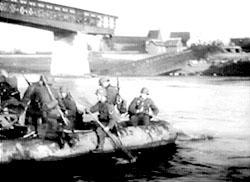
bridges complicates passage over Juliana Canal, German engineers build pontoon
bridges, large enough to support tanks. Pushing deeper into Holland, battle
scenes. Belgium, tanks advance deeper into Belgium, fording waterways by makeshift
crossings and rafts, the Maastricht bridgehead falls into German hands. Closing
montage cites Hitler's words, "This battle will seal the fate of the German
nation for 1,000 years", battle scenes, song, "Watch on the Rhine.
16 min.
 VOLUME
8
VOLUME
8
ca. 57 min. - Newsreel 507 (23 May 1940), The war thus far, map display segment
summarizes Allied war aims and Hitler's responses, the May 10th invasion of
the West portrayed as preemptive blow, in view of "imminent escalation
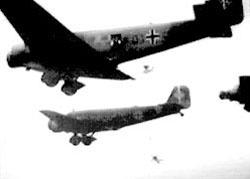
by the adversary". Holland campaign, German paratroopers dropped over Rotterdam,
deep behind enemy lines, paratroopers advance fighting roof to roof, Luftwaffe
bombing raids over city and harbor provide support. Elsewhere, German troops
overrun Dutch defense lines, pushing deep into Holland, and finally arrive at
Rotterdam. The SS Leibstandarte and a Panzer division spearhead the assault,
upon entering city, they link up with embattled paratroopers. Heavy bombardment
scenes, as the city sues for peace, large portions of it are on fire, unchecked
fires blaze into the night, scenes from next morning show massive destruction,
overhead, an aerial survey of the damage. The campaign in Belgium, eastern Belgian
province of Liege falls, capture of Fort Eben Emael, near Dinant, massed French
forces are caught off-guard by Panzer divisions, for the first time, a tank
battle pits French and German forces, Stuka air support helps Germany overwhelm
the enemy. French POWs taken, General von Reichenau reviews advancing troops,
German forces move onwards. Target, Sedan, objective, breaching Maginot line.
May 13, heavy shelling softens up Sedan installations, Guderian's Panzers break
through, the Maginot Line is breached. German infantry moves into adjoining
town (Sedan), after house-by-house search and destroy, the town is captured.
Closing montage lauds continuing German advance, in "hot pursuit"
of enemy. 28 min. Newsreel 512 (27 June 1940), The battle for Alsace-Lorraine,
reclaiming Strasbourg, Colmar, and Metz for Germany, Metz crowd welcomes German
soldiers. Triumphal entry into Verdun, site of the worst battles of WW1, now
France's major war memorial. High Symbolism as German army stages ceremonies
on Verdun grounds. Marshal Petain agrees to German armistice terms, 3 French
armies and 500,000 men now German prisoners of war. Mopping-up operations o
the Loire, gutted French tanks announce another German victory. Exhausted German
soldiers finally rest. At Supreme Headquarters, Hitler and his generals receive
Petain's agreement to German terms, in presence of inner circle, Hitler signs
and accepts Petain's offer. A meeting between Fuehrer and wounded soldiers,
cheers as Petain announces France's capitulation in radio address. On to Munich,
for a summit with Mussolini, jubilant crowd scenes in front of Fuehrer's balcony.
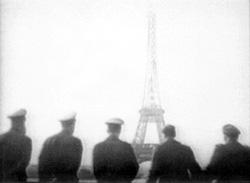
Paris, German military ceremonies at Arc de Triomphe, military procession down
Avenue Foch. June 21, cease-fire talks between France and Germany held in Marshall
Foch's railway car in Compiegne Forest (where German envoys had signed the Armistice
of 1918). Hitler leads German delegation, General Huntziger heads the French.
Upon hearing German demands, French delegation seeks approval from Bordeaux
government. June 22, signing of Franco-German cease-fire, June 25, upon consulting
Italian interests, the cease-fire is implemented, "the greatest victory
in German history". Closing montage, German flags, church bells, gothic
spire, swastikas. 29 min.
 VOLUME
9
VOLUME
9
VICTORY IN THE WEST (July 1940): Featuring: Germany's "Endless Columns"
Stream Into Conquered France; National Socialist Welfare Aids French Civilian
Refugees; Liberating German POWs; French POWs: the "Black Brothers of the
French Infantry"; German Engineers Spearhead French Reconstruction; Back
to Normal in Amsterdam and Brussels; Publishing Westfront in Paris;
Parisian Crowds Hear German Peace Terms; Hitler Visits Parisian Landmarks; Fortifying
Europe against British Attacks; Germany's Navy Prepares for War with Britain;
Air Defense Drills Staged for King George VI in England; Hitler Greets Victorious
Troops in Alsace-Lorraine; The "Inseparable Bond" between Fuehrer
and Soldiers; Hitler and Entourage Visit Strasbourg Cathedral; Hitler Inspects
Shattered Maginot Line; The Rhine: "firmly in German Hands"; Hitler's
Return to Berlin: Jubilant Germans Greet the Fuehrer; Preparing the Celebration
in Berlin; Surging Berliners Salute Hitler's Motorcade Procession; Hitler
and Goering Review Joyous Crowds at Chancellery. Two newsreels, b&w, total
running time 46 minutes, English subtitles.
 VOLUME
10
VOLUME
10
INSIDE THE THIRD REICH (July/August 1940): Featuring: Italy's Role in Defeating
France: Skirmishes on Alpine Front and French Rivera; Mussolini Inspects Alpine
Front; Italian Navy Patrols Mediterranean; Italian Fighters in East Africa;
Gibraltar: Britain's Mediterranean "Choke-point"; Fear Grips
the British Empire: Hong Kong; Britain's Crimes at Lorient; German-French
Cooperation in Rebuilding Occupied France; Germans Evacuees Return Home to Merzig;
Hitler's July 19 Reichstag Address: Churchill's Last Chance for Peace;
Joyful Berlin Crowds Greet Returning Wehrmacht Division; Goebbels and General
Fromm Hail Victorious Soldiers; Sport and Exercise for the German Girls League;
1940 German National Art Show
Opens in Munich; German Industry and Military Might: Manufacturing Panzers;
On the Job: Exercise Programs Prevent Worker Injury; RAF Bombing Raid on Hamburg
; France's Aggressive Designs Exposed; German Technicians Rebuild France;
Everyday English Routines Resume in Channel Islands; U-Boots Return from Battle;
Doenitz Awards Iron Cross; Luftwaffe Reconnaissance Missions; Montage of German
Air Strikes over England. Two newsreels, b&w, total running time 44 minutes,
English subtitles.
 VOLUME
11
VOLUME
11
THE BATTLE OF BRITAIN (August/Sept 1940): Featuring: 28th German East Trade
Fair in Koenigsberg Attracts Hundreds of Thousands; Chemical Fertilizers: Germany's
Indispensable Weapon; Salvaging Wrecked Vehicles from Western Campaign; "Strength
through Joy" Sponsors Soldiers' Factory Tour; Arms Workers see their
Products in Action; German Flak Batteries Deter Enemy Bombing Raids; Field Marshal
von Brauchitsch Visits Wounded Soldiers; Hitler Awards Field Marshals with Jeweled
Scepters; Italian Bombing Raids Open Campaign against British Somalia; Testing
New Long-range Artillery; Luftwaffe Steps up Bombing Raids Against Britain;
Total Blockade of Great Britain Begins; Labor Corps Spearheads Germanization
in Eastern Territories (Wartheland); Ethnic Germans Return to Alsace-Lorraine:
"German Virtues" Prevail; Baden Hitler Youth join Young Germans in
Strasbourg; Clearing British Mines from Norway's Fjords; U-Boots Return
to Harbor; 4.3 million Tons of Enemy Shipping Sunk in First Year of War; Germany
Fortifies the Channel Coast; Coastal Artillery bombards Dover; Coastal Air Defense:
Messerschmitt Fighter Planes Intercept RAF in Channel; RAF Bombardier Reaches
Berlin; Germany vows Revenge; Germany's New Air Strategy: London now the
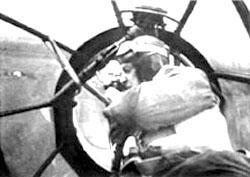
Key; Raid on London: Inside a JU 88 Dive bomber; Luftwaffe Unloads "Monumental
Destruction" on London. Two newsreels, b&w, total running time 46 minutes,
English subtitles.
 VOLUME
12
VOLUME
12
BRITAIN IN FLAMES (September/October 1940): Featuring: Fascist Labor Corps in
Norway;
Hitler grants Hungary Disputed Romanian Territory; Horthy celebrates; Franco's
Envoy visits Hitler at Chancellery; Italy's Colonial Minister Teruzzi meets
Hitler, tours Western Front; Festive Saarbruecken greets Repatriated Germans;
Todt Organization in Saarbruecken; Mine Warfare: from Factory Assembly to Mine
laying at Sea; Italian Bombers raid British Base at Sollum, Egypt; British Air
Raid Kills German Children; Goering tours Air Fields in northern France; Luftwaffe
Squadrons take Revenge upon London; Stuka Fighters in Action; Mussolini rebuilds
Rome; Reich Education Minister Rust awarded Honorary Degree in Rome; Madrid
Arena hosts Reichswehr Band Concert; Spain invades Tangiers; French Authorities
capitulate; Bulgaria seizes Contested Dobruja Province; King Boris hailed in
Sofia; Ethnic Germans from Bessarabia repatriated by "Resettlement Commandos"
; Oslo Fascists declare "Norway Needs More Quislings"; Occupied Warsaw
prepares for Hitler's Visit; Vichy Outrage as RAF "Night Pirates"
bomb LeHavre; "Fastest Gun in the West": Messerschmitt 109; Spectacular
Aerial Dogfights over southern England; Germany's Navy Girds for Battle.
Two newsreels, b&w, total running time 48 minutes, English subtitles.
 VOLUME
13
VOLUME
13
(November 1940): Featuring: Bountiful Vegetable Harvest in Germany; Autobahn
Construction in Austria; SA Officers Tour Liberated Eastern Districts; Cross
Section of Activities in France Under German Occupation; Japanese Bombers Attack
Burma Road; Victorious U-boats Return to Bases; Reich Marshal Goering reviews
Richthofen and Horst Wessel Fighter Wings; Japan Takes Over Formerly French
Indochina.; Dutch Fascists Parade in Amsterdam; Outstanding Armament Workers
are invited to Berlin as Guests of Top Nazi Leaders; Molotov Meets with Ribbentropp
and Hitler in Berlin; German Housing Settlements in Warta Region; Berlin and
Hamburg Children relocated to Safe Havens in Countryside; Flak Batteries Duel
English Night Bombers; Memorial Services Honor Fallen Soldiers in Flanders;
Coastal Batteries and Luftwaffe Planes Attack British Convoys in the Channel.
 VOLUMEOrder
# CH 813 $29.95
14
VOLUMEOrder
# CH 813 $29.95
14
(Nov./Dec. 1940): Featuring: Devastating Romanianearthquake Prompts German Aid.;
Italian Front Lines in North Africa; Ethnic Germans Depart Bessarabia for Fatherland;
Foreign Ministers of Spain (Suñer) and Italy (Ciano) Visit Hitler at
Berchtesgaden; Hitler Attends Vienna Ceremony as Hungary Joins Tripartite Pact;
Romania's Antonescu and Slovakia's Tuka also sign Tripartite Pact; "Victory
in the West" Exhibit Opens in Vienna; Luftwaffe stages a Massive Raid on
Coventry; Daring Exploits of U-boat Lieutenant Kretschmer, Germany's "Tonnage
King"; Mountain Troop Artillery Exercise In Austrian Alps; Night Raid on
Targets in England: Birmingham in Flames; Admiral Raeder Launches Battleship
Bismarck; Exploits of U-boat Captain Endress: a Surface Battle with an Armed
British Steamer and the Torpedoing of a Freighter.
 VOLUME
15
VOLUME
15
(December 1940):Featuring: Field Marshal Von Brauchitsch
Visits Troops in the East; King Michael of Romania Reviews a Parade of German
Advisory Troops in Bucharest; The completion of Oslo-Bergen Highway in Norway;
The Old Orient Express Railway Line Rebuilt in France; Reich Leader Alfred Rosenberg
Speaks at the Chamber of Deputies in Paris; Wounded Soldiers make Christmas
Toys for Children; Hitler Blasts Capitalism and "Fake Democracy" in
an address to German Armament Industry Workers; Japanese Planes Bomb Chiang
Kai-shek's Supply Lines on Burma Road; Abducted Spanish Civil War Children Return
Home from France; Life in Warsaw is back to Normal Again; New Airfields are
Constructed in Norway; Rifle Making at a Famous Gunsmith Plant in Steyr; Captured
British Submarine is Converted to a U-boat and Commissioned Under the German
Battle Flag; German Soldiers on Guard Duty in Stormy Weather on the Channel
and Channel Islands.
Click on the links below to view descriptions of other
films from the series
"Through Enemy Eyes"




The swift collapse of the Third Reich in the spring of 1945
brought, with the surrender, mountains of films and documents covering the entire
period of the Nazi regime. Perhaps no other period in history is as well documented.
Many of these films are now historical documents of a time when madness and
hate overran mankind. Some films made in those years do not reflect current
official views of Germany, its people, or other nations and should be used only
with extreme parental discretion and guidance. Almost 55 years have passed since
the terrible holocaust. The memories and the consequences are still with us
today. HOW...WHY... could such a system have arisen and flourished? How many
times have the questions been asked? How many answers have been offered? The
voices on these video tapes are the voices of history... perhaps those who listen
today can help answer the questions posed by these terrible years!
 VOLUME
16
VOLUME
16
(January 1941): Featuring: Germany's and Italy's Ambassadors Attend Ceremonies
Commemorating the Formation of the Tripartite Pact in Tokyo; Marshal Petain
Warmly Received by a Large Crowd in Lyons; Soviet Ambassador Dekanazov greeted
by Hitler at Reich Chancellery; Reich Labor Service Role in the Battle of Britain
Hailed; Extensive Grading Work Along the Vistula River in Occupied Poland; Former
Luxury Hotel in Zakopane now Shelters Berlin Children; Nazi Leaders and the
German People Celebrate their Second Wartime Christmas; Japan Celebrates the
Twenty-sixth Centenary of its Imperial Dynasty; Third Reich and Soviet Union
sign Four New Agreements in Moscow; Heavy Snowfall Reported Throughout Europe;
Dutch National Socialist Rally in Utrecht; Reich Marshal Goering Receives Congratulations
and Gifts on His 48th Birthday; Motorcycle Riflemen on Maneuvers in Occupied
Southern France; Adolf Galland Shoots Down a British Plane - His 57th Kill.
 VOLUME
17
VOLUME
17
(Jan./Feb.,1941): b&w, total running time 42 minutes, English subtitles.
FEATURING: Norwegian Workers Depart to Germany; Reconstruction Projects in Occupied
Poland;. Franz Léhar Conducts one of his Operettas in Paris; Ceremonial
Meeting of the German Academy in Prague; Japanese Military Delegation in Berlin;
Luftwaffe Bombs Valletta, Malta; Aircraft Carrier H.M.S. Illustriousis Hit;
Hitler Attends the Funeral of Justice Minister Guertner; Heavy Bombers Raid
Scottish Coastal Shipping; Auxiliary Cruiser on a Combat Mission in Tropical
Waters; A Hitler Castigates the Versailles Treaty as "the Greatest; Injustice
in History" and Issues a Warning to Germany's Enemies. Two newsreels.
 VOLUME
18
VOLUME
18
(February, 1941): b&w, total running time 48 minutes, English subtitles.
FEATURING: Funeral of Hungary's Foreign Minister Csáky; Reich Youth Leader
Axmann Visits Oslo; A Grandiose Nazi Party Ceremonies in Silesia; Submariners
on a Skiing Holiday; Minesweepers Patrol the English Channel; Bombing Raids
of British Positions in North Africa; Meeting of Mussolini and Franco in Bordighera,
Italy; German Film Stars Attend Festivities in the Reich Film Chamber; Police
Sports Festival in Berlin; World Champ Boxer Max Schmeling Volunteers for Airborne
Duty; SS General Sepp Dietrich Inspects the "SS Leibstandarte Adolf Hitler";
An Auxiliary Cruiser on the Prowl in the Atlantic. Two newsreels
 VOLUME
19
VOLUME
19
(March, 1941): b&w, total running time 50 minutes, English subtitles.
FEATURING: Hitler Speaks at the Party Founders Day Celebration in Munich's Hofbraeuhaus;
Bulgaria Signs the Tripartite Pact in Vienna; Hitler Receives Tripartite Delegation
at Belvedere Palace; German Troops are Allowed in Bulgaria "to Prevent
British Intervention in the Balkans"; Infantry Units on Winter Maneuvers;
German Air Defense Exercises; Sports Events in Berlin and Stuttgart; Vienna
Celebrates Third Anniversary of Anschluss; A Celebration Rally in Linz, Austria;
Heroes Memorial Day Rituals in Berlin; Victorious U-boat Crew is Decorated;
Combat Engineers Maneuver in France; Initiation Ceremonies of Hitler Youth and
German Girls League; Japanese Foreign Minister Matsuoka Welcomed in Berlin.
Three newsreels
 VOLUME
20
VOLUME
20
(April, 1941): b&w, total running time 48 minutes, English subtitles. FEATURING:
Second Anniversary of Bohemia and Moravia Celebrated in Prague; President Tito
Reviews Slovak Army Parade; Ethnic Germans Flee Yugoslavia; First Enlisted Man
Decorated with a Knight's Cross; Afrika Korps on the Offensive in North Africa;
German Shipyards Launch New Submarines; Germany Attacks Yugoslavia and Greece;
Afrika Korps Units Capture Agheila and Benghazi; Combat in Croatia and Slovenia;
Waffen SS Units Approach Belgrade; Metaxas Line Breached in Greece; Key Port
of Salonica Taken by German Troops. Two newsreels
 VOLUME
21
VOLUME
21
(April/May 1941) FEATURING: Afrika Korps Advance to Sollum; The Fuehrer Welcomes
Bulgarian King Boris and Hungarian Regent Horthy; Yugoslavia Capitulates; German
Troops in Historic Sarajevo; Greek Islands Thasos and Lemnos Captured by a Daring
Sea Assault; Greece's Epirus and Macedonia Armies Capitulate; Rudolf Hess Presents
Awards at a Messerschmitt Factory; Hitler Speaks in Berlin's Sportpalast and
in the Reichstag; Afrika Korps Units Converge on Tobruk; Ancient Battle Site
of Thermopylae in German Hands; Occupation Troops in Athens; Crossing the Gulf
of Patras into Peloponnesus. Two newsreels, b&w, total running time 45 minutes,
English subtitles.
 VOLUME
22
VOLUME
22
(June 1941) FEATURING: Rommel Meets with Italian General Gariboldi at the Tobruk
Front; Tank Battles in Cyrenaica; Luftwaffe Units Prepare to Invade Crete. (Operation
Mercury); German Paratroops invade Crete; German Mountain Infantry and Paratroopers
Pursue the Enemy; Luftwaffe General Student Salutes Victorious Paratroopers;
Hitler Receives Croatia's Head of State Ante Pavelic; New Alsace SA Units in
Strassburg are Sworn-in; Heavy Bombing Raid on Birmingham; Port of Canea Captured
in Crete; The Swastika Flies over Crete; Afrika Korps Soldiers Visit a Bedouin
Camp. Two newsreels, b&w, total running time 47 minutes, English subtitles.
 VOLUME
23
VOLUME
23
(June/July 1941) FEATURING: Ceremonies of Croatia's Entry into the Tripartite
Pact; Rommel Awards the Iron Cross to Italian General Gariboldi; Luftwaffe Bombs
British Munition Ships in Front of Tobruk; Germany Attacks Soviet Union. (Operation
Barbarossa); Wehrmacht Units Advance Toward Kaunas, Lithuania; Luftwaffe Attacks
Strategic Targets in Soviet Territory; German Troops Arrive in Finland; Fortress
Kaunas Taken by German Troops; Swift Advance Toward Minsk; Two Soviet Armies
Encircled near Bialystok; Soviet Citadel of Brest-Litovsk Captured; Bedraggled
Soviet Prisoners shown. Two newsreels, b&w, total running time 50 minutes,
English subtitles.
 VOLUME
24
VOLUME
24
(July 1941) FEATURING: Bavarian Mountain Infantry Capture Lemberg (Lvov) after
Heavy Fighting; Ukrainian People Greet German Soldiers as Liberators; Soviet
Atrocities in Lemberg are Depicted; Jewish GPU Agents are Turned over to German
Forces; 70,000 Soviet Troops Surrounded near Minsk; Heavy Battles Rage in Lithuania;
Street Fighting in Libau (Liepaja), Latvia; Volunteers from all over Europe
Join the Fight against Bolshevism; Finno-German Soldiers Capture the Stronghold
of Salla; Romanian Troops March into Bessarabia; Strong Soviet Defense Encountered
in the Kiev Salient; Soviet Armies Surrounded in Bialystok-Minsk Region, 325,000
Surrender; The Highly-touted Stalin Line Breached at many Key Points; German
Troops Capture Riga; Mechanized Forces Attack Toward Leningrad. Two newsreels,
b&w, total running time 63 minutes, English subtitles.
 VOLUME
25
VOLUME
25
(July/August 1941) FEATURING: Volunteers from Denmark, Spain and Italy Depart
to Germany; German Destroyers Attack Soviet Patrol Boats near Murmansk; A Bridgehead
established Across the Dnieper River; Hungarian and Slovakian Troops Advance
Deeper into Ukraine; Heavy Combat in Vitebsk, Polatsk and Smolensk Areas; First
Luftwaffe Bombing Raid on Moscow; Hitler Visits the Eastern Front; After Heavy
Fighting Bessarabia Freed From Soviet Occupation; Vinnitsa and Mogilev Taken
by German and Hungarian Troops; Smolensk Captured After Heavy Street Fighting;
Scenes of "Soviet Paradise" in Ramshackle Smolensk; Waffen-SS in Combat
Northeast of Lake Peipus; Luftwaffe Fighters and Flak Shoot Down Numerous Soviet
Planes
 VOLUME
26
VOLUME
26
(August 1941) FEATURING: Volunteer Legions From France, Flanders and Denmark
Join the Crusade Against Bolshevism; Masses of Soviet Soldiers Captured in Ukraine;
Wehrmacht rapidly advances on all Eastern Fronts; German Troops reach Gulf of
Finland; Soviets are Routed from the Baltic States; Luftwaffe Bombing Raids
in the Lake Ilmen Area; German Planes Attack the Port of Murmansk; Romanian
Troops March on Odessa; Panzer Units Reach the Black Sea Port of Nikolayev;
Battle of Gomel -- 90,000 Soviet Prisoners Taken; Heavy Combat Along the St.Petersburg
- Moscow Railroad; Novgorod Captured by German Assault Troops. Two newsreels,
b&w, total running time 56 minutes, English subtitles.
 VOLUME
27
VOLUME
27
(September 1941) FEATURING: New U-boats Launched to Reinforce the Atlantic Front;
Admiral Doenitz Decorates Victorious U-boat Commanders; Narva and Luga Fall
to Germans; Wehrmacht Troops Advance to Leningrad; Mussolini and Hitler Tour
the Eastern Front; Waffen-SS Forces Sweep into the Port of Kherson; After Fierce
Resistance Germans Capture Gomel; Stukas Destroy Bridges in the Murmansk Area;
Finnish Troops Liberate Viipuri (Vyborg), Old Capital of Karelia; German Troops
Approach the Outskirts of Leningrad; Four Soviet Armies Encircled by Guderian's
and Von Kleist's Panzer Armies; Heavy Fighting Rage for the Cities of Kremenchug
and Chernigov; German Troops Fight their Way into Kiev. Two newsreels, b&w,
total running time 61 minutes, English subtitles.
 VOLUME
28
VOLUME
28
(October 1941) FEATURING: Daring Invasion of the Islands of Oesel (Saaremaa)
and Moon (Muhu) in the Gulf of Riga; German Forces Converge on Leningrad from
all Directions; Italian and Romanian Troops at the Gates of Odessa; Kiev, the
Capital of Ukraine, "Liberated from Bolshevik Terror"; The Encirclement
of Four Soviet Armies in the Kiev Area nets 665,000 Prisoners; Goebbels Opens
the Winter Relief Fund Drive Rally in Berlin's Sportpalast; Hitler Speaks at
the Rally and Blasts "Warcriminal Plutocrats and Bolsheviks"; Mop-up
Operations in the Island of Oesel; German Artillery Pulverizes Leningrad - the
Siege Begins; Army and Waffen-SS Units Advance on Valday Hills, Source Waters
of the Volga River; Aftermath of the Battle in the Kiev Front - Endless Lines
of Soviet Prisoners; U-boat Action in the Battle of the Atlantic. Two newsreels,
b&w, total running time 61 minutes, English subtitles.
 VOLUME
29
VOLUME
29
(November 1941) FEATURING: Italy's Foreign Minister Count Ciano Visits Hitler
at hisWolfsschanze Headquarters.
Finnish Divisions Advance South of Lakes Ladoga and Onega.
Knee-deep Mud Hampers Supply Convoys in the Leningrad Area.
Soviet Stronghold of Kaluga captured by German Troops.
The Historic Battlefleld of Borodino Penetrated by Waffen-SS andGeneral Hoeppner's
Panzers.
In the Southern Sector of the Front German Infantry Advance on Kharkov.
Mop-up Operations in Karelia.
Winter Clothes and Supplies Reach the Eastern Front.
Attack on Soviet Outer Defence Ring near Moscow.
The Soviet Industrial Hub of Kharkov Captured by the Wehrmacht.
German Advances in the Crimean Peninsula.
Victory Parade of Odessa Veterans in Bucharest.
General Rommel Decorates Valorous Afrika Korps Soldiers.
Naval Action on the English Channel.
Two newsreels, b&w, total running time 59 minutes, English subtitles.
 VOLUME
30
VOLUME
30
(November/December 1941) FEATURING: State Funeral of Ernst Udet, Chief Air Inspector
General of the Luftwaffe.
Heavy Artillery Pounds Strategic Targets in Leningrad.
Important Rail Junction of Tikhvin Captured by German Troops.
Deep Frost Impedes the Advance to Moscow.
Infantry Units Reach the Crimean Capital Simferopol.
German Troops Enter the Historic City of Yalta on the Black Sea.
Stukas Attack Enemy Tanks and Troop Concentrations on the Libyan-Egyptian Border.
"Grossdeutschland" Regiment in Action near Moscow.
Reich Marshal Goering in Conference with France's Marshal Petain.
One of the two U-boats that sank British Carrier "Ark Royal" Returns
to Port.
German and British Fighter Planes in a Dogfight over the English Channel.
Colonel General Guderian's Panzers Attack Southwest of Moscow.
Italian and German Troops Battle the Brits and New Zealanders in North Africa.
Two newsreels, b&w, total running time 53 minutes, English subtitles.
 VOLUME
31
VOLUME
31
(January 1942) FEATURING: Enthusiastic German People Donate Warm Clothing for
the Soldiers on Eastern Front.
Finnish Troops Counterattack in East Karelia.
Skis are a Necessity in Snowbound Eastern Front.
In Leningrad Sector German Infantry Prevents a Bolshevik Breakout over the Neva
River.
Heavy Combat near Sevastopol in Crimea.
Reich Foreign Minister Ribbentrop Received by Hungarian Regent Horthy in Budapest.
The Fuehrer Awards Oak Leaves to the Knight's Cross to Waffen-SS General Sepp
Dietrich and other Officers.
National Socialist Women at Work Making Camouflage Suits for Winter Warfare.
German Mine Sweepers in Action on the English Channel.
Siege of Leningrad - Soldiers Routine Activities Behind Front Lines.
Heaviest Artillery Pounds the port- and Citadel of Sevastopol.
Two newsreels, b&w, total running time 45 minutes, English subtitles.
 VOLUME
32
VOLUME
32
(February 1942) FEATURING: Hitler Speaks to the German People on the Ninth Anniversary
of his Rise to Power.
General Muñoz Grandes, Commander of Spanish Blue Division, Receives the
Iron Cross, First Class.
Supply Lines Operate Around the Clock in Cities Behind Front Lines of the Eastern
Front.
German and Romanian Troops Attack Sevastopol and Feodosiya in the Crimean Peninsula.
U-boats Deploy Against the USA.
German and Italian Troops on the Road to Benghazi, Libya.
Training at Various German Officer Candidate Schools.
Wintry Woes in Snowbound Woods of Karelia.
Continued Fighting on the Eastern Front.
Colonel General Rommel on the Outskirts of Benghazi.
German U-boats in Action off the Coast of New York.
Precision Teamwork of Luftwaffe Fighters and Kriegsmarine Units on the English
Channel.
Two newsreels, b&w, total running time 53 minutes, English subtitles.
 Volume
33
Volume
33
(March/April 1942) Three newsreels, b&w, total running time 79 minutes, English
subtitles. FEATURING:
* Japanese military operations in the Pacific (Japanese Newsreel Footage Included).
* Hitler Decorates General Model at the "Wolf's Lair" headquarters.
* Scenes of Russian Winter.
* German and Romanian Troops Surround Sevastopol.
* The Luftwaffe bombs Malta.
* Aftermath of British Bombing Raid on Paris.
* Hitler Opens the Memorial Day Festivities in Berlin.
* Winter Warfare in the Donets Region in Russia.
* Armed Forces Day Celebrated in Berlin.
* The British Naval Raid on the German-held port of Saint-Nazaire.
* German troops in action on the Central Sector of the Eastern Front.
* German raider in the Indian Ocean.
* British Air Attack on Lübeck destroys the Lubeck cathedral.
 Volume
34
Volume
34
Three newsreels, b&w, total running time 83 minutes, English subtitles.
FEATURING:
* Wilhelm Fürtwangler conducts the Berlin Philharmonic Orchestra at an
Armaments Plant in Berlin.
* Reich Marshal Göring Congratulates Field Marshal Milch on his 50th Birthday.
* German troops advance into the Kerch Peninsula in the eastern Crimea.
* Italian and German Navies in the Mediterranean.
* Tank Battles in Cyrenaica, Libya.
* Hitler's 53rd Birthday Festivities.
* Luftwaffe Bombing Raid on Malta.
* Island of Suursaari in the Gulf of Finland Occupied by German and Finnish
Troops.
* The Continuing Battle for Leningrad.
* Dnieper Power Plant Rebuilt by Todt Organization Personnel.
* Gen. Franco Reviews a Parade in Madrid.
* Hitler and Mussolini meet in Salzburg and at the Berghof.
* German Armament Workers Honored on May Day.
* German Soldiers and Horses Struggle Against Mud and Flooding in Russia.
* Luftwaffe FW190 Fighter Planes in Action over the English Channel.
 Volume
35
Volume
35
Three newsreels, b&w, total running time 80 minutes, English subtitles.
FEATURING:
* Reichsleiter Alfred Rosenberg receives Farmers from Ukraine, Belorussia, and
Russia.
* Fight against Soviet Partisans in the Crimea.
* JU 52 Cargo Planes Ferry Supplies to Forward Units on the Eastern Front.
* U-boat Action in the Atlantic.
* Romanian Troops Parade in Bucharest.
* Captain Topp's U-boat Returns to Port after Sinking 7 Allied Freighters.
* German and Finnish Troops in Action on the Murmansk Front.
* After Heavy fighting Kerch in the Crimea Captured by German Troops.
* Hitler Flies to Finland and Meets with Finnish President Ritti and Field Marshal
Mannerheim.
* Massed Soviet Tanks and Infantry Attack German Positions near Kharkov.
* German, Italian, Romanian and Hungarian Troops Counterattack and Surround
3 Soviet Armies.
* Nearly a Quarter of Million Soviet Soldiers Surrender.
 Volume
36
Volume
36
Two newsreels, b&w, total running time 58 minutes, English subtitles.
FEATURING:
* Funeral Services for Assassinated SS General Reinhard Heydrich in Prague and
Berlin.
* Capture of Bir Hacheim by Afrika Korps.
* Siege of Sevastopol - Last Pictures of a German Cameraman Killed in Action.
* After Bitter Fighting, German and Romanian troops surround Sevastopol.
* In North Africa Rommel Directs an Attack on the British 8th Army.
* Fierce Fighting in the Gazala Line - in 10 Days the British Lose over 10,000
men captured and 550 Tanks.
* German and Italian Troops Launch an Attack on British-held Tobruk.
* Tobruk Capitulates - Field Marshal Kesselring Enters the Captured Fortress.
* Advance guard reaches the Port Area of Sevastopol.
NOTICE: Volumes 37 - 45 are not available at this time. They
will be listed when and if they become available.
 Volume
46
Volume
46
ca. 58 min. - Newsreel 618 (8 July 1942), Hitler awards medals to Waffen-SS
Lieutenant General Eicke and fighter pilot Marseille. Finland's Marshal von
Mannerheim visits Hitler and Goering, Halder, Jodl, Himmler, and others are
present. Volkhov Front, a trick-photography map sequence depicts Soviets' failed
attempt to free Leningrad, mud and marshes, bridges and corduroy roads built,
Waffen-SS troops smoke out Soviets, Army and SS troops, including Spanish, Dutch,
and Flemish volunteers, seize a village, HE-111s and Stukas attack Soviet positions,
captured weapons. Elsewhere on the Eastern Front, tanks, infantry, and engineers
capture a Soviet village. Final phase of Sevastopol battle, Stukas attack military
installations, German and Rumanian infantry and engineers advance, Field Marshal
von Manstein views captured fortress of "Maxim Gorki" corps, Rumanian
engineers clear minefields, harbor area reached, captures Soviet armaments.
Africa after Tobruk victory, troops swim in Mediterranean, Rommel interrogates
captured English generals, talks to Kesselring, rejoins eastward-bound units,
German-Italian tank army captures Mersa Matruh, British prisoners include non-Caucasians,
marching song.31 min. Newsreel 619 (15 July 1942), In Prague, Emil Hacha, President
of Bohemia and Moravia, celebrates his 70th birthday. Student days of German
art in Salzburg. The German art exhibit of 1942 in Munich. Field Marshal von
Manstein reports to Hitler. Scenes of U-boat homecomings, Admiral Doenitz presents
a medal. In the northern Arctic Sea, a British-American convoy is destroyed
by German aircraft and U-boats. Other Northern-Front scenes, pilots return to
base at Murmansk and General Stumpff awards medals, General Dietl arrives at
an airfield with a Labor Service detachment, in Finnish waters, Soviet bombers
attack German minesweepers, and German patrol boats battle Soviet high-speed
boats. Advance toward the Don, tanks and infantry force their way into a village,
engineers build a road and remove a demolition charge, Stukas attack retreat
routes and Soviet columns, the Don is reached, aerial view of captured Voronezh.
27 min.
Volume 47
ca. 60 min. - Newsreel 621 (29 July 1942), Extensive footage of Atlantic and
Channel coast defenses, including fortifications, weapons, planes, and ships.
Hitler greets General Munoz Grandez of Spain. Stukas, infantry, and tanks help
win the Chersonese peninsula struggle, which marks the end of the battle for
Sevastopol and the Crimea, Soviet prisoners are shown. In the middle sector
of the Eastern Front, a Soviet unit is intercepted between the Doenitz and the
Don, where a long trick-photography map sequence depicts the course of battle,
including the capture of Voronezh and Rostov, long lines of German infantry,
augmented by a Rumanian unit, march southeastward, and advance party faces enemy
by planes and fights resistance in a village, weapons are ferried across the
Don, Stukas attack troops and installations, Rostov is taken. 35 min. Newsreel
627 (8 September 1942), In Budapest, the Reich Administrator's son, killed as
a military pilot, is buried in a state funeral with von Ribbentrop and Keitel
in attendance. Africa, supplies are flown in from Greece, fighter pilots, including
First Lieutenant Marseilles, return to base, where Rommel, Kesselring, Cavallero,
and Bastico are present, German and Italian troops move into Siwa, an Egyptian
oasis city captured from the British, where sheiks hold a reception and soldiers
bathe in "Cleopatra's Bath", In the east, Goring greets wounded soldiers.
In the middle sector of the Eastern Front, soldiers set up an artillery observation
post in a destroyed theater and Soviet tanks are confronted. The battle for
Stalingrad, long lines of troops march along the bend of the Don, horses bathe
in a river, captured Soviets bring their own weapons to a collection point,
Stukas attack enemy bunkers, tanks, artillery and armored infantry win a battle,
the Volga is reached, Stalingrad fortifications come under fire. At the Caucasus
Front, the German infantry marches south, Caucasian militiamen do police work
in Pyatigorsk, a light mountain infantry company climbs Mount Elbrus to seize
a weather station. 25 min.
Volume 48
ca. 33 min. - Newsreel 629 (23 September 1942), Wounded soldiers take an NSDAP-sponsored
excursion in Carinthia. The British landing attempt at Tobruk is repulsed by
coastal batteries. Stalingrad, tanks and infantry thrust into the city, street
fighting rages, bombers attack, deep ravines, Stalingrad in flames. 14 min.
Newsreel 630 (30 September 1942), African front, freighters taking equipment
from Italy to Africa are attacked by British bombers, and one is shot down,
railway to the El Alamein Front, supply depot, Rommel, Kesselring, and fighter-pilot
Marseille, Alexandria is bombed. On the Atlantic coast, a Japanese submarine
enters a German base, where it's greeted by Admirals Doenitz, Raeder, and others,
after which the crew engage in sports and games. Also on the Atlantic coast,
two successful submarine commanders receive medals. In the far north, Stukas
attack Murmansk harbor. Stalingrad, a Focke-Wulf reconnaissance plane spots
pockets of resistance, which are then softened up, flak wards off a Soviet air
attack, German tanks advance. At the Caucasus Front, light mountain infantrymen
in the Mount Elbrus area use pack animals to bring supplies to positions high
in the mountain, a Soviet attack is repulsed. 19 min.
Volume 49
ca. 65 min. - Newsreel, 631 (7 October 1942), Foreign Minister von Ribbentrop
receives the Italian and Japanese ambassadors on the second anniversary of the
signing of the three-power pact, and predicts a new order in Europe. Rommel
reports to Hitler and speaks to domestic and foreign reporters about events
in North Africa. At the Berlin Sports Palace, the 1942-43 Winter Relief drive
opens, Goebbels reports on amounts given and disbursed in previous years and
Hitler affirms homeland support for the front-line soldier. In the northern
sector of the Eastern Front, a water conveyor is devised by soldiers and food
is delivered to the front, Waffen-SS men protect the builders of a forest position,
a captive balloon guides firing on Soviet positions, South of Lake Ladoga, tanks
and infantry combat Soviet forces, artillery destroys a Soviet bunker, Labor
Service men under Soviet attack take up arms. At another Eastern Front site,
an assault troop reconnoiters under fire. Behind the Eastern Front, soldiers
and peasants harvest wheat on a state farm. Junker 88s attack Soviet troops.
Stalingrad, a command post, destroyed Soviet planes, ravines, advancing infantry,
ruins, the Volga. 23 min. Newsreel 632 (14 October 1942), The opening segments
are devoted to food production. First, an NSDAP rally on Harvest Thanksgiving
Day includes the presentation of a medal to the Director of Faming and a speech
by Goering, who stresses the importance of food production in the occupied eastern
territories. Then trains carrying food for soldiers and industrial workers from
the Ukraine into Berlin are shown. Last, an extended segment using charts shows
how food supply in 1942 is greater than in the corresponding periods of World
War 1, and the importance of future food production is stressed. On the Caucasus
Front, supplies and mail are delivered by pack animals to light mountain infantrymen
who cross snowfields and glaciers to their position, a Soviet attack is repulsed
by soldiers in the Mount Elbrus area. Stalingrad, a Soviet tank attack is repulsed
by artillery, destroyed American and English tanks are shown, Soviet captives
march to collection centers South of Lake Ladoga, artillery, tanks, infantry,
and Luftwaffe battle the Soviets. Waffen-SS units engage the Soviets southeast
of Lake Ilmen. Aerial views of the bombing of Soviet roads and railways. 24
min. Helferinnen der Wehrmacht (The Armed Forces Women's Auxiliaries), This
short portrays women who work as volunteer signal auxiliaries for German Armed
Forces. Their work is said here to free soldiers doing similar jobs for action
at the front. The women's role in air defense and their recreational activities
are highlighted. 141 seconds. Newsreel 633 (21 October 1942), Authors from 16
nations, including Bartels and Schaefer, meet in Weimar. An Italian submarine
sinks a freighter. Two successful submarine commanders return to their Atlantic
bases. A Navy unit advances north from Norwegian waters. In the Leningrad area,
Soviets try unsuccessfully to cross the Neva River, south of Lake Ladoga, scattered
Soviet resistance is quashed, and array of destroyed Soviet weaponry is shown.
In Stalingrad, artillery and Luftwaffe fire at important plants on the Volga,
street fighting. In the Caucasus, German units march toward Tuapse, attacking
a village, and German bombers attack the oil fields of Grozny. 16 min.
Volume 50
ca. 55 min. - Newsreel 635 (4 November 1942), Mussolini attends ceremonies honoring
the 20th anniversary of the March on Rome, Party Labor Director Robert Ley heads
the NSDAP delegation and brings a message from Hitler. A Japanese naval unit
deploys ships and planes in battle. In Stalingrad, Stukas and infantry attack
the gun factory 'The Red Barricade'. At the Caucasus Front, a reconnaissance
plane pinpoints Soviet positions around Terek, which are then attacked by SS
"German volunteers", light mountain infantrymen climb the Galabashi,
refreshing themselves at a sauna, a German mountain patrol repulses a Soviet
patrol. At the Egyptian Front, German and Italian units led by Rommel, including
armored units and paratroops used in land combat, defend the El Alamein position
against the British. 17 min. Newsreel 637 (18 November, 1942), November 9th
ceremonies in Munich and Berlin honor National Socialist martyrs. Defenses in
Norway, including fortifications, coastal batteries, air patrols, runways, and
naval units. Finnish Front soldiers build houses for families of fallen comrades.
Near Leningrad, the Soviet fortress Kronstadt and Soviet battleship Marat are
fired on, German and Croatian planes bomb Leningrad defenses. Italian infantry
repels a Soviet attempt to cut the supply line to Stalingrad. In Stalingrad,
the destroyed Cherchinsky tractor works and other devastation. In France, German
motorized units advance through unoccupied territory to the Mediterranean, they
are said to be answering the English-American attack on North Africa and anticipating
an invasion, friendship with the French is affirmed, German units arrive in
Marseilles. 20 min. Newsreel 638 (25 November 1942), Members of a domestic flak
unit at an armaments plan in action. Soldiers and weapons move into new positions
on the French Riviera. A convoy taking supplies from Italy to Africa is attacked
by English torpedo planes. In Stalingrad, Stukas and artillery hammer the Soviets,
close-ups of German soldiers. On the Black Sea, a German-Rumanian naval unit
primes and lays mines. In the Mount Elbrus area of the Upper Caucasus, members
of a ski patrol spot a Soviet assault troop and race down the mountain to warn
their comrades, the Soviets are repulsed. 18 min.
Volume 51
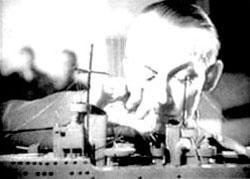
ca. 59 min. - Newsreel 639 (2 December 1942), Training in German submarine schools,
including classroom work, simulation exercises, and work with models. Homecoming
at a U-boat base with Admiral Doenitz in attendance. On the French Mediterranean,
view of Marseilles, Axis infantry, air power, and artillery guard the coast
after French officers intentionally scuttled part of the French fleet in an
attempt to deliver the fleet and Toulon harbor to the Allies. A German-Italian
convoy brings vehicles, mail, and supplies to Tunisia. German and Italian planes
attack the British-American fleet near Algiers with torpedoes and bombs. In
the Leningrad area, a train brings supplies to the front, Soviets are opposed
by artillery and planes including a Croatian bomber squadron. Along the upper
Don, Hungarians and other German allies repulse a Soviet attack. In the middle
section of the Eastern Front, another Soviet attack is encountered. 19 min.
Newsreel 640 (10 December 1942), Mussolini speaks before the Fascist Chamber
in Rome, condemning Churchill and defying the Allies. At the Berlin Sports Palace,
Goebbels speaks to local Party leadership, vowing that Germans will fight to
victory in the war that has been forced on them. A lengthy trick-photography
map sequence reviews one year of war in Asia, describing motivations of English,
the US, and Japan and recounting Japanese victories in Wake, Guam, the Philippines,
Hong Kong, Java, and other Pacific locations. Subsequent footage shows Japanese
in action, conquering Singapore, parachuting into Celebes, and making a marine
landing on the Aleutians. Behind the lines of the Eastern Front, men of the
Reich's Labor Service join the Armed Forces. To the South of Lake Ilmen, Stukas
and SS armored infantry lead a successful attack on a Soviet village. In the
middle sector of the Eastern Front, the year's first snow falls, tanks get their
winter camouflage, a Fieseler Storch plane relays orders to a motorized unit
to attack a Soviet base, and the Soviet counterattack fails, behind enemy lines,
planes bomb Soviet shelters, supply depots, and traffic junctions. 20 min. Newsreel
642 (21 December 1942), In the Leningrad area, a messenger travels on ice skates,
snow screens are set up/ soldiers on the front line. In the middle sector of
the Eastern Front, tanks get winter camouflage, trucks battle snowy roads, gunners
respond to Soviet artillery. At the Tunisian Front, German bombers attack US
tanks near Tebourba, destroyed American tanks and a downed American fighter,
German enter Tebourba, captured British parachutists and captured Americans,
supplies come to Tunis and a supply depot is set up. The film ends with many
Christmas segments, soldiers celebrate Christmas in Africa, in a submarine,
in Lapland, and in the Caucasus, soldiers make toys for children of fallen comrades,
artist's wives and female artists prepare packets for front-line soldiers, as
do schoolchildren and nurses at a leave center, children visit and sing for
soldiers at an Army hospital. 20 min.
Click on the links below to view descriptions of other
films from the series
"Through Enemy Eyes"

The swift collapse of the Third Reich in the spring of 1945
brought, with the surrender, mountains of films and documents covering the entire
period of the Nazi regime. Perhaps no other period in history is as well documented.
Many of these films are now historical documents of a time when madness and
hate overran mankind. Some films made in those years do not reflect current
official views of Germany, its people, or other nations and should be used only
with extreme parental discretion and guidance. Almost 55 years have passed since
the terrible holocaust. The memories and the consequences are still with us
today. HOW...WHY... could such a system have arisen and flourished? How many
times have the questions been asked? How many answers have been offered? The
voices on these video tapes are the voices of history... perhaps those who listen
today can help answer the questions posed by these terrible years!
Volume 52
ca. 48 min. - Newsreel 647 (27 January 1943), Scenes from Eisenach, including
the Wartburg. Ten years of National Socialist rule are illustrated, unemployment
conquered, new construction, new German art, new dwellings, care for mothers
and children, Hitler Youth, "Strength Through Joy" recreation programs
for workers. The film says enemies have been trying to disrupt this peaceful
development, but have been thwarted by heroism at the front and by homeland
mobilization. an extended sequence details night-fighter operations, enemy planes
spotted, air-raid-warning headquarters, pilots at leisure, command post directing
pilot, enemy plane shot down. Western Mediterranean Theater, after ships taking
arms to Tunisia are attacked by British torpedo planes, one of the planes is
shot down and the crew is rescued, in Southern Tunisia, tanks and armored infantry
battle French troops. In winter battles in the Leningrad area, a Soviet observation
post is destroyed and engineers readying a trench for defense are attacked by
a Soviet unit, which is defeated with the aid of anti-tank forces. In the Velikiye
Luki area, a horse-drawn field kitchen, a field medical station, knocked-out
Soviet tanks, close-ups of soldiers. Southeast of Lake Ilmen, a Soviet attack
is repulsed, assault tanks join up with armored infantry for a counterattack.
At another (unnamed) location on the Eastern Front, Germans repulse Soviet.
26 min. Newsreel 648 (3 February 1943), foreign Minister von Ribbentrop and
Ambassador Ohshima sign the German-Japanese economic treaty. At the conference
of the Reich's Labor Chamber, Party Labor Director Ley speaks and awards are
given to workers and firms. In the honorary hall of the Reich's Ministry of
Aviation, Goering speaks to the Armed Forces, saying Germans are the guarantors
of Europe's survival. At the Berlin Sports Palace, Goebbels speaks to the German
people, proclaiming the dedication of the home front to the soldiers and the
Fuehrer and reading a proclamation from Hitler that speaks of the Armed Forces
standing up to the Asian threat. U-boat in the South Atlantic, receiving and
loading torpedoes from another boat, sighting a neutral (Swedish) ship, sinking
an American yacht. North Africa, passing Carthaginian ruins on way to base in
Southern Tunisia, life on and defenses of base, light infantry clashes with
Americans, destroyed American tanks and American machete, German fighters attack
British bombers, successful pilots shown with Field Marshal Kesselring. On the
Finnish Front, a relief unit advances and snow is cleared from roads, a forward
artillery observer gets a medal. In the Leningrad area, supplies are brought
to the front by rail, and a railroad gun is fired. In the middle sector of the
Eastern Front, a signal unit sets up communication links and a Soviet attack
is repulsed by flak and infantry. 22 min.
Volume 53
ca. 60 min. - Newsreel 651 (24 February 1943), In the Berlin Sports Palace Goebbels
speaks at length to the German people, audience members, including women, soldiers,
and other representatives of social groups, are often shown. Goebbels affirms
that Germany and its allies are the only bulwark against Soviet aggression and
asks the audience if it wants "total war" with total home front dedication,
to which the audience replies affirmatively loudly and often. A large part of
this segment uses original sound, including Goebbels' voice. Subsequent footage
shows German women getting jobs at armaments plants, freeing men for duty at
the front. On the Tunisian Front, weapons are shipped from Italy to Africa,
Gabes and its defenses are reviewed by Rommel. In the Southern sector of the
Eastern Front, soldiers retreat, accompanied by members of the local populace
said to fear the Soviet "yoke", a captive balloon directs fire, winter
rigors are stressed, bombers and fighters attack Soviet railroads and vehicles.
17 min. Thomas, This comic vignette, in verse, delivers the message that electricity
should be conserved to save coal. 87 seconds. Newsreel 652 (3 March 1943), New
armaments plants. Half-track motorcycles are manufactured and tested. Reserve
soldiers train in a garrison yard. Goering reviews the Hermann Goering division,
a fully-motorized Luftwaffe unit. At the Tunisian Front, German tanks battle
their American and English counterparts. In the southern sector of the Eastern
Front, 2500 horses from Caucasian stud farms begin their journey to the Ukraine,
retreating German units destroy telegraph poles and bridges behind them, and
are said to be protecting locals accompanying them. Between the Dnieper and
the Donets, Waffen-SS units and the SS Bodyguard Regiment Adolf Hitler battle
the Soviets. Somewhere on the Eastern Front, a pilot gets a medal from Lieutenant
General Korten, Stukas bomb Soviet targets, and Soviet fighters are engaged.
20 min. Newsreel 654 (17 March 1943), New armaments plants, with women workers
featured. On the Channel and Atlantic coast, the Reich's Labor Service and the
Todt Organization build fortifications, a Navy outpost ship faces a storm, English
bombers are sighted and German fighters intervene. On the Eastern Front, field-maintenance
soldiers overhaul planes. Soviet partisans are hunted, a short-range reconnaissance
plane brings data for evaluation, security police, riding sleighs and tracked
vehicles, attack a village where partisans are hiding, peasants offer the police
helpful information, partisans defeated, a Fieseler Storch plane brings seized
documents about nearby partisans. To the south of Lake Ladoga, snow is removed
from roads, a telephone unit is attacked, Soviet ground-attack planes are downed,
Stukas and infantry counter-attack, knocked-out Soviet tanks, a Dutch SS gunner
receives a medal. Between the Dnieper and the Donets, Army and Waffen-SS units
advance against Soviet tank unit and village, Stukas and other planes bomb supply
depots and troop concentrations. 21 min.
Volume 54
ca. 50 min. - Newsreel 655 (24 March 1943), Heroes' Memorial Day in Berlin,
Hitler, Himmler, Goering, Keitel, Doenitz, and others attend ceremonies at the
Armory, where Hitler praises the German soldier for protecting Europe from "Bolshevik"
aggression, Hitler passes a battalion of honor and greets wounded soldiers.
In the North Atlantic, a U-boat stalks a British convoy, a British escort plane
forces the U-boat to submerge, torpedoes are released, depth charges shake up
the U-boat and its crew, after surfacing, the crew view a torpedoed British
steamer. In Greece, heavy weapons roll through Athens, transport ships go to
Crete, defenses on Crete. The battle for Kharkov, tanks and motorized infantry
units of the Waffen-SS advance toward Kharkov, tanks and infantry attack a nearby
village, German troops break into Kharkov, where hard street fighting ensues,
ahead of the assault troops, German planes strafe and bomb Soviet troops and
trains. 22 min. Newsreel 658 (14 April 1943), In the South Pacific, the Japanese
land on New Guinea despite American resistance and seize the British airport
at Salamaua, from this base, their bombers take off for Northern Australia and
bomb Port Darwin. On the Eastern Front, where land has turned into mud, corduroy
bridges are built. Between Lake Ladoga and Lake Ilmen, trenches are full of
water, signs of spring, the Soviet attack collapses, General Weiss praises the
German infantrymen. On the Lapland Front, Haflinger horses servicing as pack
animals deliver mail and supplies to a forward base. In the Karelian forest,
a new Soviet base is seized. A wounded soldier travels from Norway to Germany.
Hitler meets with Mussolini, von Ribbentrop and Keitel appear. Hitler awards
a medal to Admiral Doenitz, who visits his men. U-boat in the Caribbean, off-duty
activities, a torpedo barrel is fixed and a torpedo loaded, the cook makes a
Christmas cake, a Christmas greeting from Admiral Doenitz is read, and gifts
are exchanged, through the periscope, Curacao is visible, a steamer is sunk.
19 min. Im Wald von Katyn (In the Katyn Forest), This short tells the story
of pits filled with over 12,000 dead Polish officers found in the Katyn Forest
near Smolensk in the Soviet Union. The film contends that these officers were
murdered, many by being buried alive, by the Soviet Secret Police in 1940. The
corpses are shown in graphic detail. Forensic investigation and investigative
groups from many nations are spoken of and shown 8 1/2 min.
 Volume
55
Volume
55
ca. 59 min. - Newsreel 661 (5 May 1943) - At the conference of the Reich Labor
Chamber in the Reich Chancellery, director of Organization, Robert Ley, stresses
the role of the workplace in national victory. Awards are given to firms, managers,
and workers. On the western front, Reich Labor Service men at work and at leisure,
a bicycle unit, after a British bomber formation is sighted, German flak and
fighters are employed and one British plane is downed. At the front to the southeast
of Leningrad, A thaw has turned land in the Volkhov area into lakes and rivers,
supplies transported on rubber boats, posts and positions surrounded by water.
In the middle sector of the eastern front, Soviet movement spotted, message
relayed to rear, firing coordinates calculated, firing commences, village ablaze
after deluge of Soviet incendiary bombs. A defensive battle in Tunisia, German-Italian
tank units retreat to new positions at the foot of the Atlas Mountains, their
defenses and weapons are shown, Stukas and infantry help defeat a British-American
tank attack, destroyed enemy tanks are shown. A U-boat in the Atlantic gets
fuel, torpedoes, and provisions from a transport ship, cooking, eating, and
leisure pursuits, spotting and sinking of a British freighter. 23 min. Newsreel
663 (19 May 1943), Field Marshal Busch speaks at General Brockdorf-Ahlefeld's
state funeral at the Berlin Arsenal. In Seeboden on Millstaetter Lake, the second
preliminary training camp for Germanic youths is held. Training riding horses
and pack animals for work with mountain troops. Defenses on the Atlantic, Channel
and Mediterranean coasts, including fortifications, reconnaissance planes, flak
guns, railway guns, and infantry, the Todt Organization, Department Head Dorsch,
and Reich Labor Leader Hierl are also shown. A convoy taking munitions through
the Corinth Canal repels an attack from British bombers and torpedo planes.
In the Middle sector of the eastern front, police units attack partisans in
farmsteads, capturing leaders. In the southern sector of the eastern front,
a mail wagon arrives, a local folk dance, a Cossack regiment in the Wehrmacht
demonstrates horsemanship, General Nehring. At the Kuban bridgehead, Stukas
and artillery attack Soviets, Brigadier General Friebe is present. 16 min. Newsreel
666 (9 June 1943), A rally for military volunteers in the Galician town of Kolumea,
where the Governor speaks. Hitler Youth volunteers for the Waffen-SS assemble
for a roll call, where Himmler speaks and Reich Youth Leader Axmann is present.
In Vienna, the 54th Division is renamed the Hoch und Deutschmeister Division
to its service on the eastern front, Baldur von Schirach announces the award.
Luftwaffe training center for flak-gun ground warfare. In the east, soldiers
close to the front get books from a mobile "front bookstore" and engage
in sports. At a dockyard on the Dnieper, Ukrainians under German supervision
repair barges left behind by Soviets. At the Kuban bridgehead, a reconnaissance
patrol traverses a reed thicket to find Soviet positions, which are then attacked
by artillery. Armaments, many kinds of armament and armaments factories are
shown, statistics proving increased production are adduced, armaments workers
receive medals from General Heinz Guderian, General of the Waffen-SS Sepp Dietrich,
and others, after the awards ceremony, Goebbels speaks, saying that the eastern
front is holding firm and that unshakable Germany, forced to fight for its life,
will be victorious in the end. 20 min.
 Volume
56
Volume
56
ca. 46 min. - Newsreel 668 (23 June 1943), A ship takes children from Berlin
to a camp on the Baltic Sea as part of the KLV ("Sending children to the
Country") program. The German Opera Orchestra, conducted by Hans Schmidt-Isserstaedt,
performs at a tank plant. Women train to be Luftwaffe signal auxiliaries. At
a mass rally in Dortmund, Goebbels speaks to a populace hard hit by Allied air
raids, saying they must not break down under this terror because the War, which
will determine the future of the German nation, will finally be won by Germany.
Waffen-SS anti-tank units train. Italian Admiral Riccardi gives Italian medals
to German sailors on the Mediterranean coast. Riccardi and Emperor Victor Emmanuel
at Italian Navy Day in Rome, where medals are awarded. Training at a U-boat
school, including classroom work, demonstrations with a model, and countering
U-boat chasers in field exercises. In Helsinki, Major General Malmberg takes
over command of the Waffen-SS Finnish volunteer battalion. German artillery
fires at targets in the Leningrad harbor area, south of the city, a Soviet attack
is repulsed and a Soviet observation post is eliminated. At the Kuban bridgehead,
Germans find and attack a Soviet unit, Soviet tanks are repulsed, and German
bomber groups attack Soviet supply depots. 22 min. Newsreel 669 (30 June 1943),
Championship soccer match between the Dresden Sport Club and Saarbruecken Soccer
Club at the Reich Sports Field. Works in an art exhibit in Munich opened by
Goebbels. In Vienna, Alfred Rosenberg and Reich Press Chief Otto Dietrich speak
to an international conference of journalists. In the Rhenish-Westphalian region,
British bombers are countered by flak and night fighters. Bombing damage in
Krefeld. Aftermath of bombing in German civilian areas, fire fighting, Food
given out by field kitchens, streetcar cable repaired, ruins of cultural monuments
and social-welfare institutions. In Southern France, the 60th Infantry Division
is honored in recognition of SA performance, SA General Huettner is present.
In Montenegro, Waffen-SS units and others destroy a partisan stronghold and
capture partisan leaders. On the eastern front, an infantry battalion rests,
letter writing, games, sports listening to Wehrmacht radio communiqué
reporting relative quiet on the front. Fresh divisions advance to the eastern
front. 24 min.
 Volume
57
Volume
57
ca. 48 min. - Newsreel 670 (7 July 1943), Bombed-out Cologne, Cathedral. Boys
and girls in a sports festival of the Berlin District Hitler Youth held at the
Olympic Stadium, including gymnastics and track. General Guderian visits an
NSKK (National socialist Motor Corps) tank-driving school. On the eastern front,
soldiers' Midsummer Day celebration and assault unit attacks a Soviet advance
post. Japanese officers visit the front between Leningrad and Lake Ilmen. A
Turkish military mission visits the southern sector of the eastern front, Field
Marshal von Manstein is present. In Minsk, police raid enemy agents and saboteurs.
Army and Waffen-SS units and French Legion volunteers destroy a Soviet partisan
group. A makeshift streetcar in Orel. Russians celebrate liberation from Soviet
rule. Russian military volunteers on German side. A night reconnaissance plane
parries a Soviet ground attack. In the English Channel, a German advance post
on a lighthouse island. Off the French coast, a submarine-hunting flotilla destroys
a British submarine with depth charges. 24 min. Newsreel 672 (21 July 1943),
Wartime German swimming championship at Erfurt, including racing and diving.
German soldiers attend a bloodless bullfight in Arles, France. Grand Admiral
Doenitz inspects new U-boat crews. U-boats escorted by destroyers put out to
sea, a British aerial attack on the boats is countered. A massacre of Ukrainians
near Vinnitsa is said to have been perpetrated by Jewish henchmen of the Soviet
secret police, the Ukrainians' funeral is shown. In the Orel area, German supply
columns, Field Marshal von Kluge, Soviet infantry against German artillery,
Luftwaffe bombing Soviet staging areas. Belgorod battle sector, German rockets,
tanks, fighter planes, infantry, assault units, and Stukas oppose Soviet planes,
tanks, and infantry, captured Soviet soldiers and guns, German prefabricated
bridge, General Model. 24 min.
 Volume
58
Volume
58
ca. 43 min. - Newsreel 674 (4 August 1943), Agricultural scenes, harvesting
rape, Hitler Youth picking peas, Flemish girl working in the Warthegau, gooseherd
from Norway, wheat harvest. Children in the Baltic Sea learn and play as part
of the KLV ("Sending Children to the Country") program. The eastern
front assault group Briesen is feted in Luebeck and visits Hitler Youth at a
camp. At Hitler's Wolfsschanze headquarters, the Fuehrer is joined by Field
Marshal Keitel, Japanese Ambassador Oshima, Field Marshal Milch, Albert Speer,
Joseph Goebbels, and others. A U-boat tanker bringing supplies to a U-boat in
the Atlantic must evade a British reconnaissance plane, the transfer of various
supplies is shown. On the Leningrad front, artillery, including a railway gun,
fire at Soviet factories, troop concentrations, and an observation post. Orel
combat zone, HE-111 bombers attack Soviet supply routes, German supply truck
convoys, a "native" unit attacks partisans in a village, captured
Soviet solders and weapons, German soldiers resting, tank battles, German rocket
batteries, destroyed Soviet and US tanks. 24 min. Newsreel 675 (11 August 1943),
English bombers unsuccessfully attack a convoy including outpost patrol vessels
on escort duty. Other British bombers are countered by flak and shot down by
night fighters. Piles of British and American aircraft wrecks. Soldiers and
armaments workers see 'Die Meistersinger von Nuernberg' at Bayreuth. Wounded
soldiers take a pleasure trip down the Isar River from Toelz. Soldiers on leave
and wounded soldiers from the Leningrad front go home on East Prussian Naval
Service ships. On the Mediterranean front, Rommel and tanks in Salonika, Lieutenant
Brandi, the most-successful German U-boat commander in the Mediterranean, returns
from a victorious mission,, glider transports carry men and material, transport
planes carry paratroops and supplies over the Straits of Messina to the Sicilian
defensive front, Germans fight British, American, and Canadian tanks and infantry.
On the eastern front, Germans evacuate Orel, bombers, Stukas, tanks, rockets,
and infantry attack Soviets, Soviet tanks in a village are surrounded, ME-110
bomber formations attack. Soviet reserves, tank concentrations, and columns
east and northeast of Belgorod, an ME-110 destroys two Soviet fighters. 19 min.
 Volume
59
Volume
59
ca. 38 min. - Newsreel 679 (8 September 1943), Tuna fishing on the Atlantic
coast of Spain. Members of the Serbian construction Service, modeled on the
German Construction Service, dig drainage ditches. In Breslau, the seventh Hitler
Youth Summer Games (boys and girls participating), including gymnastics, track
and field, swimming and diving. A German city after a bombing attack, downed
bombers, civilians given supplies and evacuated from city. Hitler on a morning
walk. Himmler, von Manstein, Goering, Doenitz, Keitel, Jodl, and Korten consult
with Hitler at his headquarters. On the Eastern Front, a Soviet breakthrough
is repulsed by artillery, rocket batteries, and tanks, which are countered by
Soviet assault planes and artillery. Germans withdraw from Sicily across the
Straits of Messina while their flak repels bomber attacks, General Hube is shown.
Torpedo bombers leave an advance airfield in the Mediterranean and attack a
British convoy. The auxiliary cruiser Thor interdicts enemy merchant ships,
routine activities on the boat, enemy ships are captured, a steamer is sunk.
20 min. Newsreel 680 (15 September 1943), in memory of the recently deceased
King Boris of Bulgaria, his last visit to Hitler's headquarters is shown. Boris's
funeral in Sofia, lying in state in the Alexander Nevsky cathedral, procession
to the railway station, Queen Ioanna, King Simeon II, Raeder, Keitel, and von
Steengracht are present. Hitler Youth members display their skills on Pre-military
Training Day. The crew of the auxiliary cruiser 'Thor' visit Japan, Captain
Gumprich and Japanese Navy officers are shown. On the Easter Front, the Speer
Brigade of the National Socialist Motor Corps, reinforcements move into quarters
on the front, German artillery, assault guns, flak, rockets, and Stukas, destroyed
Soviet tanks, Soviet wounded, dead, and prisoners, Major General von Schwerin
awards decorations. German troops march into Italy, where they are warmly received,
Kesselring is shown. 18 min.
 Volume
60
Volume
60
ca. 49 min. - Public Service Message, After a bomb attack, a civil-defense official
tells people in an air-raid shelter that everybody should help fight residential
fires caused by incendiary bombs. He describes the proper fire-fighting techniques
in detail while the film portrays them. He stresses that people cannot depend
on the air-defense police to fight this kind of fire because they must tend
to fires in "important buildings". 4 min. Newsreel 681 (22 September
1943), In Antwerp, the Volunteer Flemish Labor Service marches into Berchem
Stadium and presents athletic demonstrations. In Paris, the French volunteer
Legion against Bolshevism marches. In Goerlitz, events on a day honoring the
wounded include a boxing march. In Northern Norway, a reconnaissance plane takes
off from a catapult ship for its 2,000 flight. In the far north, a convoy lays
a smoke screen to counter Soviet coastal batteries. In the Arctic Ocean, a Soviet
torpedo-bomber attack on German mine-laying ships is repelled. On the Eastern
Front, German artillery and rockets, an observation post, a Soviet prisoner,
SS Brigadier General Fegelein, Fieseler Storchs, tanks encircle a Soviet unit,
Stukas bomb Soviet tanks and troops. In Northern Italy, German troops march
into Reggio, Pavia, and Milan and defeat Badoglio's troops to capture Rome.
In Southern Italy, a reconnaissance plane and reconnaissance photo, repelling
Allied landings at Salerno and elsewhere. Mussolini is rescued, commandos march
through the Abruzzi Mountains, a paratroop detachment is ordered to occupy the
valley station of a tram going to the building where Mussolini is imprisoned,
the building is approached, SS Captain Skorzeny is shown with Mussolini, Mussolini
flies to Hitler's headquarters, where he meets his son, Vittorio, Hitler, Goering,
and von Ribbentrop, Mussolini urges his followers to fight. 25 min. Newsreel
684 (13 October 1943), In Reval, Estonia, the celebration of the second anniversary
of liberation from Soviet rule. SS Lieutenant General Rauter inspects Dutch
Waffen-SS troops. Off the Baltic coast, a glider pilot, Waffen-SS First Lieutenant
Jachtmann, sets a new World record for flight time. In his headquarters, Hitler
decorates four Luftwaffe officers, Grasser, Wittgenstein, Nowotny, and Rall.
Central and southern sector of Eastern front, rations depot, military units,
accompanied by civilians, withdraw over the Dnieper, blowing up facilities left
behind, rear-guard troops attacked by Soviet planes. Southern sector of the
Eastern Front, forward Kuban bridgehead evacuated, assault unit attacks in Kuban
Lagoon region, troops withdraw to Crimia by train, accompanied by civilians,
and blow up track behind them, while ships are loading at a harbor on the Taman
peninsula, Soviet bombers attack and are repulsed by flak, Stuka formations
in action. While German destroyers are engaged in a reconnaissance thrust in
the Atlantic, a French fishing boat is inspected and enemy ships are fought
with guns and torpedoes. 20 min.
 Volume
61
Volume
61
ca. 39 min. - Newsreel 685 (20 October 1943), Medical Corps Brigadier General
Sauerbruch gives a lecture. A miner sculpts in his free time. Training at the
Women's Leader School of the Labor Service. In a motor-sport school of the National
Socialist Motor Corps, Hitler Youth learn about assault boats. In the Leningrad
combat zone, a Luftwaffe field-division assault unit blows up a Soviet bunker
and receives decorations. In the central sector of the Eastern Front, an armored
train and armored reconnaissance vehicle are used to battle partisans. On the
coast of the Sea of Azov, guns are mounted and cavalry is used for reconnaissance.
On the perimeter of the new main line of resistance in the central sector of
the Eastern Front, German infantry, artillery, tanks, and rockets repel Soviet
advances, a sergeant is awarded the Knight's Cross. A Stuka group in the east
honors Captain Rudel and his radio infantry, aided by the Luftwaffe, land on
Corfu, which is later occupied by troops. Von Weichs and Marshal Graziani in
Kesselring's headquarters. In Rome, Graziani leads a march to the National Memorial,
General Stahel (the German Commandant of Rome) and General Ricci (the commander
of the fascist militia) accompany him. battling Allied bombers in Germany, downed
bombers and dead pilots, "arrogant inscriptions" on downed bombers,
bombers made into scrap, fighter pilots, including Major Graf. 20 min. Newsreel
687 (3 November 1943), In Prague Castle, Reich Minister Frick is inaugurated
as Reich Protector in Bohemia and Moravia, Karl Frank, Czech President Hacha,
and Hans Lammers are present. Prince Cyril and Professor Filoff from the Bulgarian
Regency Council are received by Hitler and von Ribbentrop as they arrive for
a meeting in Hitler's headquarters. In a military-training camp for Navy Hitler
Youth on a lake in Southern Germany, boys learn about knots, warships, semaphore,
and sailing. Goering inspects air defense forces, is briefed by flight crews,
offers instruction, inspects a plane equipped with new night-fighting devices,
and talks with residents of an area distressed by bombing, with defense workers,
and with people in a mining settlement. General Loerzer, Brigadier General Galland,
Major Graf, Field Marshal Milch, and Professor Messerschmitt appear in this
sequence. Wounded former prisoners of war come to Stettin and a French harbor.
Lieutenant Commander Lueth and his U-boat crew return to a German base after
the longest voyage ever made by a U-boat, crew members receive decorations from
Captain Roesing, and Lieutenant Commanders Lueth, Topp, Suhren, and Gysae receive
decorations from Hitler. Hitler decorates fighter pilot Captain Nowotny. During
the invasions of Kos Island, German dive-bombers attack, German ships withstand
British bombers, the garrison is captured, village residents greet motorized
troops, and soldiers and British planes are captured. Selected shots from Eastern
Front defensive battles, including Luftwaffe, artillery, Tanks, and Soviet prisoners.
19 min.
 Volume
62
Volume
62
ca. 40 min. - Newsreel 688 (10 November 1943), In the German Alps, cattle are
driven down to the valley for fall pasturage. Morning exercises for workmen
at camp in Carinthia. Soccer final for Schamer Cup in the Adolph Hitler Stadium
in Stuttgart, in which the Luftwaffe Sport Club Hamburg opposes a team from
Vienna. In a Berlin defense plant, Albert Speer talks to youth about their labor
obligations. In the Kroll Opera House in Berlin, Youth Leader Axmann speaks
to Hitler Youth about the importance of their labor duty for the war effort.
In Posen, a celebration witnessed by Himmler and others commemorates the Warthland's
return to the Reich. Lieutenant Commander Lueth, a highly-decorated U-boat commander,
returns home to Neustadt. Work at a tank-repair installation in the southern
part of the Eastern Front. In Tirane, members of the "first government
of free Albania" are chosen. German bombers and soldiers and a Cossack
brigade assault partisans in Bosnia. In Italy, Kesselring reviews units that
fought in Sardinia and Corsica, in Mussolini's headquarters, the fascist-republican
government has its first cabinet meeting with Marshal Graziani in attendance.
Graziani meets with Rommel, Rommel inspects defensive installations in Northern
Italy, in Southern Italy, defenses are established and Allied tanks are destroyed
by artillery. In the Dnieper basin, soldiers set up in an anti-tank ditch, a
blown-up bridge, artillery fires on the opposite bank. In the area of Krivoy
Rog, a Soviet advance is pushed back by tanks and close-support planes, Soviet
dead are shown. Near Gomel, bombers attack soviet military and transport targets
despite flak and smoke screen. 20 min. Newsreel 689 (17 November 1943), In a
factory near Antwerp, dried vegetables are produced. Men whose wives and children
have been relocated learn cooking at a course given by the German Women's League.
National Socialist People's Welfare Organization wartime maternity clinics in
scenic districts. Professor Frik, a radiology researcher, examines a patient.
Albert Speer speaks to a conference of the German armaments industry, Ferdinand
Porsche, Field Marshal Milch, and Brigadier General Galland are present. New
ammunition is demonstrated to Speer. Goering visits the reserve and training
section of the Hermann Goering tank division. Viennese greet highly-decorated
fighter pilot Captain Nowotny. Officer training at Murwik Naval Military Academy,
including types of ships, navigation, mechanics, physical education, and sailing.
November 9th commemoration, On November 8th, Hitler joins old comrades in Loewenbraeu
cellar and predicts victory, on November 9th, Keitel and District Party Director
Giessler lay wreaths from Hitler and the Wehrmacht to honor Nazi martyrs. Defensive
battle on the Eastern Front. North of Krivoi Rog, German and Soviet tanks clash,
Soviet ground-attack planes attack tanks, German rockets fire, and German fighter
planes attack Soviet bombers. 20 min.
 Volume
63
Volume
63
ca. 36 min. - Newsreel 690 (24 November 1943), Convalescent home for students
injured in the war. French volunteer Legion recruits arrive at a German training
camp. In Vienna, Reich competition of the Hitler Youth Communication Corps,
Baldur von Schirach and Youth Leader Axmann are shown. In the Berlin Sports
Palace, a day for the armed forces, including two Berlin ice-hockey teams. On
the Atlantic coast of France, Japanese ambassador Oshima inspects the Atlantic
Wall. On the Arctic Front, snowplows, sleds, and skis, building materials, soldiers
take cod-liver oil. General Dietl inspects positions in the Lapland Front and
decorates a private. In Krivoi Rog, destroyed Soviet tanks and weapons. On the
Smolensk roadway, German mortars and Stuka and Soviet tanks. On the South Italian
Front, tanks on mountain roads, flak repels enemy bombers, an Italian village,
blowing up road and rail, infantry and paratroops in defensive battle. A newly-occupied
island base in the Aegean area receives reinforcements and supplies. In the
Mediterranean theater, the Gigant airplane is shown taking off, flying, landing,
and being unloaded. Doenitz and Albert Speer view naval exercises during which
speedboats attack submarines and a convoy, and Speer is aboard a U-boat during
its maneuvers, Lieutenant Commander Suhren is present. 20 min. Newsreel 692
(8 December 1943), Goering visits a coal-mining community in Western Germany.
Himmler inspects a volunteer division made up of Southeast European Muslims.
Christmas preparations, flak soldiers reserve their Christmas ducks, Red Cross
nurses prepare packages for the front, at the Atlantic Wall and at an air base,
soldiers make toys for children. Berlin's response to Allied bombing, Air Defense
command post, flak and downed bombers, Goebbels gives instructions to co-workers
about post-bombing response, barges are used as mass kitchens, the Fuchs aid
train, a food-distribution center, streets cleared and railway track repaired,
workers going to their jobs, the city commandant, emergency concession stands,
a theatrical show put on for people hurt by bombing, furniture rescued, mothers
and children leave the city, children in the safety of a national Socialist
People's Welfare Organization home away from Berlin, Goebbels gives decorations
to people for their activities after bombing, mounting of the guard on Unter
den Linden Boulevard. Defensive battles on the Eastern Front, at the Dnieper
bend, tanks advance to counterattack, infantrymen march through mud to the front,
a squad leader gets the Iron Cross, Stukas attack staging areas in the Nevel
area, infantry, tanks, and heavy artillery take high ground, and Soviet prisoners
are taken in the same combat zone. On Leros, destroyed British equipment, dead
British troops, and British and Italian prisoners, on Samos, soldiers drink
wine, Major General Mueller, leader of operations in the Dodecanese islands.
16 min.
 Volume
64
Volume
64
ca. 40 min. - Newsreel 694 (22 December 1943), Transylvanian volunteers for
the Waffen-SS leave home after being inspected by SS Lieutenant General Lorenz.
Goering inspects an airplane factory. In the mountains a National Socialist
People's Welfare Organization home for mothers and children from areas threatened
by bombing. Christmas, children see gifts, Christmas tree is given to a railroad
signalman, gifts for the wounded, women signal auxiliaries enjoy a Christmas
meal, Santa Claus in Channel-coast bunker, celebration of a minesweeper, returning
fliers greeted by Santa Claus. Rommel inspects defensive installations on Danish
coast, General von Hanneken is shown. On the Easter Front, a JU-52 drops supplies
and mail. In the central sector of the Eastern Front, artillery, infantry, and
assault guns repulse a Soviet attack, destroyed Soviet tanks. On the Italian
Front, flak in the Banco Valley repels US bombers, new positions are built,
mail is delivered by donkey, paratroopers blow up a bridge. At a seaplane base,
a reconnaissance plane return, and planes fly out to protect a convoy after
being cleared of ice and snow. The convoy's weapons are cleared of snow, on-board
guns hit an attacking enemy plane. 18 min. Public Service Announcement. This
seriocomic vignette urges the audience never to reveal militarily-important
information to anybody, a seemingly-innocent man in a railroad car asking for
directions to a factory is exposed as a spy and arrested by a Gestapo agent.
6 min. Newsreel 695 (29 December 1943), Doctor von Sicken at work. Kraft durch
Freude (Strength Through Joy) organization, Robert Ley at the tenth-anniversary
celebration, a KDF-sponsored performance is presented to soldiers on the Eastern
Front. A submarine net is laid to fight Soviet subs in the Gulf of Finland.
In the Crimea, Rumanian troops supported by German weapons encircle and destroy
a Soviet beachhead south of Kerch, Stukas, rockets, assault guns, and Rumanian
infantry, captured Soviet weapons, General Thiodorini, Soviet prisoners. On
the Eastern Front, the Gigant plane is loaded with men and equipment, flies
to an advanced airfield, and is unloaded, men and equipment join a supply train
rolling to the front. The German bridgehead at Nikopol, reinforcements arrive,
artillery fires on the enemy staging area, flak fights Soviet ground-attack
planes. In the central sector of the Eastern Front, German troops counterattack,
Soviet corpses and burned-out soviet tanks, a Soviet village is occupied, a
tank-regiment commander receives a decoration. Rockets firing somewhere on the
Easter Front. 16 min.
Click on the links below to view descriptions of other
films from the series
"Through Enemy Eyes"
The swift collapse of the Third Reich in the spring of 1945
brought, with the surrender, mountains of films and documents covering the entire
period of the Nazi regime. Perhaps no other period in history is as well documented.
Many of these films are now historical documents of a time when madness and
hate overran mankind. Some films made in those years do not reflect current
official views of Germany, its people, or other nations and should be used only
with extreme parental discretion and guidance. Almost 55 years have passed since
the terrible holocaust. The memories and the consequences are still with us
today. HOW...WHY... could such a system have arisen and flourished? How many
times have the questions been asked? How many answers have been offered? The
voices on these video tapes are the voices of history... perhaps those who listen
today can help answer the questions posed by these terrible years!
 Volume
65
Volume
65
ca. 40 min. - Newsreel 697 (12 January 1944), An exhibition boxing match is
put on for German workers and their "foreign helpers". Darnand and
Deat at an anti-Bolshevist rally in Paris. Serbian military recruits train to
fight partisans. In Bosnia, horses, boats, motorcycles, and tanks are used against
partisans, a partisan band is captured. On the Arctic Front, supplies move by
truck, sled, and cable lift, glimpse of tent interior, nurses, soldiers given
cod-liver oil, General Dietl. In the Nevel area, supplies and reinforcements
bound for the front, eastern-territory tractor, Panther tanks, German infantrymen,
German howitzers. In the Kirovograd area, German infantry and assault guns,
Soviet defectors and prisoners interrogated, destroyed Soviet tanks, tank soldiers
decorated, German rockets. Lieutenant Commander Gysae's U-boat in the Indian
Ocean, Repair work above and below water while sailing around the Cape of Good
Hope, provisions, torpedoes, and oil transferred from supply U-boat, eating
and bathing, a commercial freighter is torpedoed. 20 min. Newsreel 698 (20 January
1944), Recznizek directs his opera Donna Diana. In the Olympic Ice Stadium in
Garmisch-Partenkirchen, teams from Rittersee and Vienna compete in a preliminary
match for the German ice hockey championship. Trapeze artists and the acrobat
Sarasani. Work and break time in a German defense plant - the film stresses
that "the enemy is listening". Soldiers painting in their free time.
Brigadier General Schulz visits Nuremberg, where District Party Director Holz
greets him and he visits his parents. In the Aegean, on Samos, wine sampling
and "hospitable" population, on the southern tip of Chalcidice, soldiers
visit monks high in the mountains. At the Nikopol bridgehead, German barbed
wire and mines, German infantry, assault guns, and flak oppose Soviet tanks,
Soviet prisoners. An extended sequence about combat with Allied bombers over
Germany on January 11, German flak and fighters oppose American bombers, wreckage
of Allied planes, Allied prisoners, a fighter pilot tells how he battle American
bombers, fighter crews report to their commander after the engagement. 20 min.
 Volume
66
Volume
66
ca. 35 min. - Newsreel 702 (16 February 1944), Artist Paul Hermann at work.
Skiing championship of the Air Command at Zell am See, including slalom, cross-country,
and downhill. The Langemarck Program in Heidelberg, where soldiers on leave
and workers can earn a high-school degree. Female members of the Reich Labor
Service shown working on a streetcar in a military hospital, and in a defense
plant. Goebbels decorates Berliners who distinguished themselves in the Berlin
civil defense against bombings, including District Administrative Director Schach
and Police President Helldorf. Ley gives the Fritz Schott Prize to eight researchers
and inventors. Doenitz speaks to U-boat crews at a German naval base and awards
medals. In Italy, in the Nettuno area, an artillery duel, in Aprilia, German
artillery, Anglo-American prisoners march into Rome. In the east, soldiers leave
the front line for rest and relaxation, they see movies and receive gifts. In
Vitebsk, supplies head for the front, wounded are brought to the rear, and the
front headquarters, a movie theater, and the Panzerfaust publishing house are
shown. In the east, a motorcycle messenger drives through snow to alert a battle
group in a dugout, which is being sent to the front line, at the edge of a village,
Soviet tanks are fought with flak guns. 17 min. Newsreel 703 (23 February 1944),
The biochemist Adolf Butenandt is shown at work. At the University of Munich,
Seyss-Inquart is inaugurated as the new president of the German Academy and
speaks about the Academy's mission of "spreading the German spirit throughout
the World", Goebbels gives him Hitler's certificate of appointment. The
German Film Ballet trains and rehearses. On Tegern Lake, a convalescent home
for bomber pilots who were imprisoned in England and Canada, they meet General
Peltz and other officers, talk abut their battles, and play in the snow. A German
destroyer protects French fishing cutters by repelling an enemy bomber with
flak. On the South Italian Front, supplies move by land and sea, including by
donkey, Allied ground-attack planes bomb a valley, the Abbey of Monte Cassino
before and after Allied bombing, Allied artillery bombards the abbey after aerial
bombing, the Monte Cassino abbot goes to Rome, wounded are carried from the
ruins of Castle Gandolfo the Pope's summer residence after Allied bombing. As
German troops withdraw on the Eastern Front, they destroy everything left behind,
and a rearguard unit battles a Soviet spearhead, Panther tanks are shown. In
the Kirovograd area, a tank division, infantry, artillery, rockets, and Soviet
prisoners. At Kerch, German and Rumanian Troops battle the Soviet bridgehead,
artillery, infantry, street fighting, Stukas. 18 min.
 Volume
67
Volume
67
ca. 39 min. - Newsreel 705 (8 March 1944), Eye specialist Loehlein examining
a patient and lecturing. Wrestlers from Germany, Czechoslovakia, and Norway
compete in a tournament in Berlin - the Germans win. In Katowice, District Party
Director Bracht presents naturalization documents to ethnic Germans returning
from the Soviet Union. In Brussels, Leon Degrelle speaks, explaining how the
German combat team at Cherkassy was freed, assault troops from Cherkassy meet
Goebbels. Western defenses, tanks, infantry, and spotlights, Rommel inspects
defenses, cannon are loaded. German withdrawals through Narva, local civilians
join retreat, artillery protects rear guard. Near a forward post on the banks
of the Narva River, German rear guard counterattacks, German tanks, Infantry,
and dive-bombers, village and woods cleared of enemy, soviet prisoners and destroyed
equipment. Beachhead at Nettuno, Allied equipment left behind, wounded treated,
Allied bombers against German fighters and flak, German paratroops in Norwegian
coast carrying soldiers bound for the front spots American bombers headed toward
Germany, German fighters take off to fight an Allied air offensive that the
film says lasted six days, aerial shots of German fighters in action and American
bombers being shot down, destroyed bombers on the ground. 19 min. Newsreel 707
(22 march 1944), the poet Borries von Muenchhausen at his castle in Altenburg.
On the Mediterranean coast, a diver uses oxygen apparatus to visit a ship wreck.
Five years of Slovakian "independence". Doctor Tiso enters Pressburg
in 1939, industry and military. Marshal Badoglio at the American headquarters
in Southern Italy. Leon Degrelle at a rally in Paris,, French Waffen-SS volunteers.
In Saarbruecken, exchange wounded soldiers and civilian internees return from
America. On the radio program Blinkfeuer Heimat, relatives send greetings to
German naval personnel stationed overseas and a song is sung (synchronous sound).
The Goliath, a remote-controlled miniature tank, in an exercise against a captured
enemy tank. Supplies for the Eastern Front carried on trains and unloaded from
truck by Estonian volunteers, a frozen Lake Pskov is shown. On the Narva Front,
a captive balloon is released, a Soviet attack using tanks and low-flying aircraft
is repulsed by German flak, tanks, assault guns, and riflemen, aided by Estonian
volunteers. Repulsing enemy bombers over the sea and coasts, fighter pilots
on the coast and in occupied areas scramble, aerial shots of bombers being shot
down, ace fighter pilot Major Baer, shot-down bombers on ground, shots from
English newsreel showing damage to bombers. Enemy bombers are combated in the
Berlin area, fighter destroys a loose barrage balloon, division command post
issues an air-raid alarm, people take shelter, fire-department brigades and
auxiliary services take their positions, flak, fighters, and heavy fighters
shoot bombers (division command-post announcements use synchronous sound). 20
min.
 Volume
68
Volume
68
ca. 36 min. - Newsreel 708 (29 March 1944), The chemist and industrialist Professor
Krauch in a laboratory that produces synthetic fiber. Women gymnasts from Berlin
and Dresden compete. At the Schiller Theater, Heinrich George talks to his co-workers
about resuscitating the theater after air attacks (synchronous sound), excerpts
from several scenes of a production of Urfaust at the theater are shown (synchronous
sound). Goebbels greets a delegation of Cassino veterans, a comic master-of-ceremonies
introduces them in a theater (synchronous sound), and one of them talks to a
table of soldiers about playing chess in a tent while under attack (synchronous
sound). German troops arrive in Budapest. U-boats in torpedo-shooting training
exercises, used exercise torpedoes brought into workshop, refilled, and returned
to U-boats. On the Finnish Front, positions dug in snow, snowplow truck, women
bring goods for the soldiers and drink coffee with them, relief for support
base. On the Eastern Front, Field Marshal Busch celebrates his fortieth year
in the military, in the Pripet Marshes, ski riflemen share cigarettes, drink
from a flare casing, reconnoiter a Soviet base, and repulse a Soviet attack
with the aid of mortars and Stukas. Cassino, German positions in ruins of buildings,
Kesselring and Major General Heidrich, bombs fall from enemy fighter-bombers,
view into valley, German artillery observer, rockets, and paratroopers in land
warfare, shots from American newsreel of Cassino street battles. 18 min. Newsreel
709 (5 April 1944), Richard Scheibe sculpts, using clay over wire skeletons.
At a bicycling festival in Singen on Lake Constance, a team of six girls appears
and a cycling champion performs stunts. A trapeze artist at a circus. Children
at a "Sending children to the Country" home in Garmisch-Partenkirchen
wake up, go to class, learn crafts, and play in the snow. Hitler Youth members
ceremonially enter the Reich Labor Service. Ski training at a Waffen-SS mountain
school in the Alps. Colonel Trautloft speaks to pilots who have volunteered
for combat duty in home air defense (synchronous sound). Night fighters from
the "Wild Sow" land at their home field and report to the wing commander.
German withdrawals on the southern part of the Eastern Front, trucks struggle
through mud, a telephone section in action, rail and factories, including those
in Nikolayev, are blown up, war material is transported over the Bug while enemy
bombers are repelled by flak. Cassino, American infantry march from Salerno
beachhead to Cassino Front, Americans and English bomb city and Monastery, German
paratroopers fight in ruins of Cassino, Major General Heidrich, German assault
guns, captured New Zealanders. 18 min.
 Volume
69
Volume
69
ca. 40 min. - Newsreel 711 (19 April 1944), Hans Pfitzner conducts his music.
In Berlin, horses race for the Easter Prize in Karlshorst. In a radio studio,
Doctor Rau reads a Goebbels editorial from Das Reich (synchronous sound). In the
Ruhr district, boys participate in the mining activities in the Wartime Vocational
Competition. In the Karelian woods, mountain infantrymen make cradles for soldier-fathers,
one soldier brings his cradle home to his baby when he goes on leave. Cassino,
ruins of Monte Cassino monastery, craters in front of Cassino, German paratroopers
and flak fight enemy artillery and tanks - knocked-out tanks shown, enemy smoke
grenades, German machine guns. On the Crimean Front, Gigant airplanes are loaded
with men and equipment and fly to the Crimean peninsula, meeting a formation of
JU-52s on the way, a naval convoy brings supplies to the peninsula, fighting a
Soviet bomber attack on a harbor city. Breaking the ring around Kovel, aerial
delivery units put on planes and released over Kovel, railroad men at work in
Kovel, low-flying Soviet planes, German armored train, tanks, mechanized infantry,
Waffen-SS units, and ground-attack aircraft, including JU-87s, Lieutenant Colonel
Hoffmann leads this operation, street fighting in suburbs, Soviet prisoners, Major
General Gille welcomes liberators, infantrymen gets Knight's Cross. 19 min. Newsreel
712 (26 April 1944), Hitler's birthday is celebrated, Nazi Party celebration on
eve of birthday features Beethoven's Eroica Symphony and Goebbels speaking about
the Germans' loyalty to Hitler (synchronous sound), the Guard Regiment and Berliners
march on Unter den Linden Boulevard, Berliners put up many Nazi flags (much bomb
damage shown), dignitaries and citizens sign congratulations list in the Reich
Chancellery, many signs and banners in Berlin salute Hitler and declare people's
unbroken spirits (much bomb damage shown), Goring, Keitel, Doenitz, Zeitzler,
Guderian, and Karl Saur congratulate Hitler as he inspects new anti-tank weapons
(Himmler is present). Southern sector of the Eastern Front, German soldiers withdraw,
joined by Bessarabian civilians, important facilities left behind are blown up,
Germans counterattack on Soviet tank using Tiger tanks and infantry. Somewhere
on the Easter Front, the Luftwaffe drops supplies for forward base, German artillery
and infantry attack village, after which communication troops lay lines and parachutes
from aerial delivery units are folded. Air defense, patrol boat spots incoming
bombers, automatic camera mounted in fighter plane, fighter pilots scramble, city
residents go to bunkers, fire patrol in factories, hospital patients moved to
bunkers, enemy planes followed in a fighter command post (synchronous sound),
extensive footage of fighters and heavy fighters shooting down bombers, American
prisoners interrogated (in English-synchronous sound), American graves and shot-down
bomber, returned German pilot talks about his battle (synchronous sound), Knight's
Cross awarded to pilot, Wing Commander Oesau talks to young fighter pilots (synchronous
sound), boys working as air-raid helpers, cities come back to life, enemy bombers
from Italy approach Southeastern Germany and flak fires on them, a Liberator is
forced to land on a German landing strip and its crew emerges, fighters and heavy
fighters shoot down bombers over the Alps (synchronous sound talking in fighter
command post). 21 min.
 Volume
70
Volume
70
Newsreel 713 (3 May 1944): District Party Director Wagner's funeral in Munich,
including procession. General Hube's funeral in Berlin; Goering and Hitler are
present. In Spain, General Franco reviews a parade honoring fifth anniversary
of the liberation of Barcelona. In Brussels, the SS assault brigade Wallonia returns
home; Leon Degrelle presents decorations in the presence of Sepp Dietrich. Final
exams for Adolf Hitler School students at a " Castle of the Knightly Order",
where Robert Ley and Baldur von Schirach are present; students' boxing and gymnastic
skills are displayed. In Munich, Berlin and Munich city soccer teams compete.
Training at a Navy blockade weaponry school, including classroom work and laying
and clearing mines in field exercises. Sniper training, including target practice
and field exercises. Hungarians and Germans on the Easter Front; soldiers bask
in sunshine; field exercises. Hungarian troops in the area of Stanislav, including
a general; German and Hungarian troops at foot of Carpathians; HE-111s drop fuel
for a forward detachment; armored reconnaissance cars and artillery; mechanized
infantrymen take a village; Colonel Lippert awards medals to Hungarian soldiers.
Western Front preparations: defenses on the Channel coast, including bunkers,
anti-tank ditches, and other obstacles; floodgates in Flanders and Holland opened;
infantrymen march; Rundstedt reviews a Waffen-SS mechanized infantry division;
Rommel; Trial alert, showing soldiers taking positions and weapons being readied;
excerpts from American newsreel showing practice for Atlantic invasion; test firing
of German cannon; mechanized units and tanks; film contends that "Jewish
regiments" are intended as occupation troops for Berlin. 20 min. Newsreel
715 (17 May 1944): Spring in the zoo of a big German city. At a large postal dispatch
center, the benefits of the postal code are demonstrated. Violence in strikes
and lockouts in America and England. German miners rest at a resort in the mountains.
Storm Troopers shooting practice for citizens, attended by Storm Troopers Chief
of Staff Schepmann. Brigadier General von Strachwitz is greeted by the populace
of a German city, receives a model of a flak gun produced at an armaments factory,
and thanks the factory workers for the weapons they're providing (synchronous
sound). French youth rally against "Jewish-plutocratic Bolshevik" enemies;
Joseph Darnand speaks to volunteers going to the Eastern Front. Situation conference
attended by Rundstedt, Sperrle, Rommel, and others. Rommel speaks to troops at
the Atlantic Wall, expressing confidence in their defensive preparations (synchronous
sound); artillery exercise sequence highlighting spoken orders (synchronous sound).
Withdrawals in the Crimea: German and Rumanian troops on the march, joined by
the civilian population; flak fights low-flying Soviet planes - one is hit and
pilot bails out; dead horses; heavy flak used in land warfare; Sevastopol left
behind in flames; under cover of artificial smoke, ships leave Crimean coast;
Soviet planes try to bomb German ships; wounded transferred to hospital ship.
The Grossdeutschland Mechanized Infantry Division in defensive action between
th Prut and Moldau: ground-attack planes support tanks and infantry; Major General
von Manteuffel; the division breaks through into soviet positions, Soviet deserters;
enemy artillery strikes; tank fire fight; prisoners, including a riflewoman; Soviet
dead; explicit contrast of Soviet and German faces. 19 min.
 Volume
71
Volume
71
Newsreel 717 (31 May 1944): Mother's Day: Mothers visit children at a "Sending
Children to the Country" camp; Styria District Party Director Uberreither
awards a Mother's Honor Cross. Professor Moeller, a female oceanographer, takes
water samples, then investigates them in a laboratory. In Krems, Austria, the
13th German Gymnastics Championship tournament. A welterweight boxing match
between a German and a Dutchman sponsored by the Service for Troop Morale. Food
distribution: newspaper ads for special food allotments; grocery store; warehouses
and trucks; Reich Minister Backe. Seriously wounded German soldiers, including
veterans of the Africa campaign, return from imprisonment in America, arriving
in a harbor in Southern France. Shots from a captured American newsreel shows
American ships being bombed by Japanese in a New Guinea harbor. In Eastern Rumania,
columns of Ukrainians and Rumanians fleeing the soviets meet marching German
soldiers and are cared for by the German Red Cross. On the Eastern Front, a
day with Highly-decorated pilot Major Rudel, including soccer, calisthenics,
breakfast, a briefing, and a dive-bombing sortie. A German police division attacks
and captures Soviet partisans in a village. On the Adriatic-Front, a German
anti-tank soldier knocks out an enemy tank and an orders conference takes place.
German defensive battle in the ruins of Cisterna, south of Rome: artillery,
tanks "Green Devils", allied prisoners (including Lieutenant Kohlmann
with crews of anti-submarine ships; a sub threatening a German convoy in the
Mediterranean is hit by depth charges. 18 min. Newsreel 719 (14 June 1944):
This film is totally dedicated to the D-Day invasion. Newspaper headlines say
the invasion was begun "on Moscow's order". At night, near the Bay
of the Seine, soldiers race into position, flak fires at planes, assault troops
fight airborne units. still at night, patrol boats warn of larger ship formations
approaching, heavy guns on German sips are in action, and a German speedboat
torpedoes a ship. A panoramic shot of the invasion fleet after the day has begun.
German coastal batteries and British warships exchange fire. Landing boats come
into the mouth of the Ome and are hammered by anti-tank guns, machine guns,
and light German reserve units encircle allied airborne troops in a forest:
a glider transport hanging from a tree, parachutes in branches, Allied dead
and prisoners, downed glider transports, Canadian (including Nova Scotian) prisoners.
Flak fires at bombers; planes bomb Caen and refugees leave. more serve units
are brought to the front. The SS Division Hitlerjugend in action: German tanks,
flak in land battle, knocked-out Allied tanks, Allied wounded and prisoners.
Street battles in a small coastal town in the Bayeux area. 16 minutes.
 Volume
72
Volume
72
Newsreel 720 (21 June 1944): Soccer teams from Hamburg and Dresden play for
the fifth German Wartime Championship. French Information Minister Henriot speaks
to French workers (synchronous sound). Sergeant Apitz tells National Political
Training Institute (Napola) pupils how he fought Soviet tanks and infantry as
a forward artillery observer (trick photography and synchronous sound). Eastern
Front soldiers relax in a newly-built resort town behind the lines, a sauna,
barbershop, mess hall, Army store, sports field, and outdoor variety show are
shown. On the Italian Front north of Rome, rear-guard units fight Allied spearhead,
Allied prisoners, Front, allied commanders confer in headquarters, Lieutenant
Commander Hofmann awards Iron Crosses to crewmen of his torpedo-boat flotilla,
Lieutenant Commander Rall, coastal batteries fire on Allied ships, wreckage
of Allied equipment on beach, flack fires at Allied aircraft, in Caen, buildings
are destroyed by Allied bombing and French civilians flee and take refuge in
caves, German bunkers undamaged in middle of bomb-cratered field, assault guns
and flak in action, a downed Allied transport glider, Allied dead and prisoners,
parachutes in trees, members of the SS Division Hitlerjugend are decorated,
an infantry flanking maneuver is supported by self-propelled artillery, heavy
flak and rocket batteries. 18 min. Newsreel 721 (28 June 1944), Actor Werner
Krauss (at home) practices lines for a stage role (synchronous sound). The Marie
von Clausewitz Home for war widows studying at Marburg University. Flak auxiliary
women on duty in an air-defense battery learn about equipment, later they relax
and play games. The Gruenau Rowing Regatta, featuring preliminaries for the
1944 Wartime Championship. The hospital ship Erlangen, after being attacked
by Allied bombers, beaches on the West Italian coast and the wounded are taken
ashore. On the Eastern Front, General von Greim at infantry advance, Soviet
aircraft are shot down by flak, German assault guns and artillery of self-propelled
mounts, a burning village is left behind by Soviets. On the Western Front, night-fighters
take off, light and heavy flak are used against allied planes, a downed Boeing
and its captured crew, shots of Le Havre showing destruction and wounded refugees,
soldiers at a forward command post are overjoyed to hear about how the "new
weapon" has hit England, SS Brigadier General Witt, said to have since
found a "hero's death", Major General Meindl talking with Major von
der Heydte, a patrol leader explains a mission. Combat in the hedgerows near
Saint-Lo, German tanks, infantry, paratroopers, and mortars, the SS Division
Goetz von Berlichingen attacks, knocked-out Allied tanks and anti-tanks guns,
intact Allied armament is left behind. German bombers, briefing, hanging bombs
on planes, takeoff. A speedboat knows out an allied ship. 21 min.
 Volume
73
Volume
73
ca. 32 min. - Newsreel 722 (6 July 1944), General Dietl's funeral, with a eulogy
from Hitler, shots of Dietl with troops. Leon Degrelle speaks to Wallonian soldiers
and workers in Berlin (synchronous sound, with German translation from narrator).
Training at an infantry school, final exercise, Lieutenant Colonel Baerenfaenger
speaks to graduates (synchronous sound), infantry song. On the Western Front,
coastal batteries fight British-American naval units, Allied wreckage on the
coast, knocked-out allied tanks, prisoners, including US paratroopers, Sepp
Dietrich at his command post, German tanks, assault guns, and rockets and artillery
on self-propelled mounts counterattack in the Bayeux area. 12 min. Newsreel
723 (12 July 1944), The poet Wilhelm von Scholz at home. Four sisters run a
sawmill because the men folk have been drafted. Women train horses for the Wehrmacht.
In Prague, the 1944 Reich Labor Service Art Show, Reich Labor Leader Hierl and
State Minister Frank open the show, paintings and sculptures by Labor Service
members depict Labor Service life. In Breslau, Goebbels speaks at a mass rally,
predicting great success for the V-1 and urging Germans to remain steadfast
(synchronous sound), District Leader Hanke and State Secretary Naumann are present.
Finland, weapons and other supplies are brought to Finnish soldiers, a German
mountain infantry company travels over a lake, a boy servicing with the Finnish
cavalry as a courier, Finnish artillery repulses a Soviet advance. Western Front,
reserves roll into the combat zone, front newspapers, marching infantrymen are
attacked by enemy planes and flak shoots one down, ravaged French coastal town
where a soldier plays the organ in a damaged church, a Waffen-SS forward detachment
holds a briefing, tanks and assault guns roll to the front, rockets are brought
into position, soldiers pet baby boar, muddy battlefield, A Waffen-SS combat
patrol is attacked, then is defended by German light artillery, tanks, infantry,
heavy artillery, and rockets in counterattack, assault-gun crew members receive
the Iron Cross. 20 min.
 Volume
74
Volume
74
Newsreel 725 (26 July 1944): July 20 attempt to assassinate Hitler: damage at
Hitler's headquarters; Hitler greets Mussolini at train station a few hours
after the attempt and confers with him and Himmler. (Graziani, Goering, and
Ribbentrop are present.) Albert Speer speaks at a defense-industry conference
and awards medals to industrial leaders Kessler, Fischer, Langenohl, and Lueschen
(Hitler is shown). Speer visits a new defense plant. A Panther tank is tested
side-by-side with American General Lee tank. Panzerfaust and Panzerschreck tested.
Eastern Front: retreating to new defensive lines; artillery on self-propelled
mounts and heavy artillery; destroying rails; rear guard leaves town; refugees
join retreating Soviet tanks and infantry; knocked-out Soviet tanks; ground-attack
planes target Soviet supply lines. Western Front: supply trucks roll to the
front; Allied planes bomb Caen; German supplies roll through a burning Caen
suburb; infantrymen move into position on the edge of Caen; and paratroopers
on the march; Allied artillery attacks a defile; assault artillery counterattacks;
Sherman tanks breaking into a village are repulsed with Panzerfaust, Panzerschreck,
and V-1 missile flies toward England. 17 min. Newsreel 726 (3 August 1944):
Genral Korten's state funeral at Tannenberg memorial; Goering gives eulogy and
lays the Fuehrer's wreath. (Doenitz and Keitel are present.) Aftermath of the
July 20th attempt to assassinate Hitler: in a hospital, Hitler visits people
wounded by the attempt, including Brigadier General Scherff, Rear Admiral von
Puttkamer, Lieutenant General Buhle, and others; when Hitler leaves hospital
a crowd cheers him. Leading party and military figures congratulate Hitler before
their "critical discussions", including Funk, Sauckel, Speer, Saur,
Lammers, Himmler, Goering, Goebbels, Bormann, and Generals Schoerner, Guderian,
and Jodl; Colonel Remer, who as a Major and Commander of the Berlin Guard Battalion
helped crush July 20th "activities inimical to the state", speaks
to his soldiers (synchronous sound) and reviews them marching. In the South
Hanover-Brunswick District, District Party Director Lauterbacher reviews People's
Army (Volkssturm) marching with members of SS, Storm Troopers (SA), Labor Service,
and Wehrmacht; he speaks to them. Author Knut Hamsun visits a U-boat crew on
their vessel. German withdrawals on the Eastern Front: fresh infantry reserves
march to the main battle line; columns of refugees; railways destroyed; militarily-important
buildings burned; infantry rear guard protects clearing of a town; at a railroad
station behind the lines, heavy weapons arrive; tanks roll to flanking thrust;
infantrymen wait in an assembly area; reserves set up prepared positions that
are then occupied by infantry; tanks and infantry counterattack. Western Front:
Norman farmers drive herds to safety and encounter German intervention reserves;
American fighter-bombers attack a French city whose population flees and tries
to recover; in Paris, French onlookers harass Allied prisoners being led through
the streets; German fighter planes attack supply lines and American vehicles;
south of Caen, SS mechanized infantrymen and tanks in action; knocked-out Allied
tanks; street fighting. 18 min.
 Volume
75
Volume
75
Public Service Announcement: A brief vignette set in a restaurant urges the
audience to keep quiet about military matters, because the enemy might overhear
them talking. 1 min. Newsreel 727 (10 August 1944): In the east, Hitler Youth,
Labor Service, and workers (including women) from the Baltic area dig defensive
trenches. Eastern Front action between the Baltic and the north Carpathians,
including replacements rolling to front, artillery and tank counterattack, SS
mechanized infantry and others taking village, SS Major General Gille, and knocked-out
Soviet tanks. Western Front activity, including Milice (French Militia) interrogation,
German Field Police, French counterfeit money, Allied planes attacking German
infantry reserves, Field Marshal Klug, Allied tanks being knocked out by infantrymen
and paratroopers, and German tank counterattack. Allied ships that were hit
in English Channel. U-boat on combat mission in North Sea (lengthy synchronous-sound
sequence). 15 min. Newsreel 729 (24 August 1944): Employment of women in factories,
streetcar conducting, police work, and fire brigades. Young Knight's Cross winner
visits hometown. Western Front: reconnaissance forces on Brittany country roads;
vehicle used to lure Allied fighter-bombers into attacking; flak; wreckage of
downed Allied planes; German infantry, assault guns, flak anti-tank guns, armored
reconnaissance cars, and tanks in action; knocked-out Allied tanks; first-aid
station; Allied prisoner. Putting down the uprising in Warsaw: artillery and
tanks; prisoner; street battles; civilian dead; Major General Stahel; flak bombarding
observation post; SS units and armor-piercing weapons; civilians "evacuated"
from city. Easter Front: SS and tank reconnaissance units close gap in the front;
assault guns, tanks, infantry, and riflemen intervene; tiger tanks, bumblebee
howitzers, and anti tank guns combat Soviet tanks; ground-attack planes; reinforcements
leave homeland for front; train with troops and material for front leaves home
district; Tiger and Panther tanks lines up. 13 min. Newsreel 730 (31 August
1944): "Total War" measures in Germany affect newspapers, places of
entertainment, women's employment in defense production, streetcar usage, and
civilians digging defensive trenches on eastern border. On the Eastern Front,
the campaign to capture Tukums and Kemeri to re-establish connection with Courland
troops; tanks from East Prussia advance on Soviet barrier in front of Riga;
naval task force fires at Soviets on Courland coast; Soviet tanks trying to
block breakthrough are countered by flak and Panzerfaust; swastika flag waves
over Kemeri. Counteroffensives on other points on the Eastern Front: infantry
mounted on assault guns; reconnaissance vehicles; assault guns engage Soviet
tanks; burning T-34; Two soldiers are decorated by Brigadier General von Zielhlberg.
Western Front: American newsreel shows V-1 and English flak defense; Allied
bombers threaten tank troops and are hit by flak: light flak and infantry take
a section of forest; light flak prevents formation of Allied bridgehead on river;
Allied tanks burning on French country roads. 13 min.
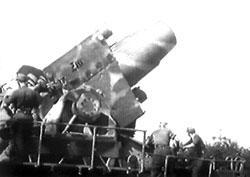 Volume
76
Volume
76
Newsreel 731 (7 September 1944): Agriculture: mountain-farmer family working;
70-year-old farmer working his hereditary farm (Erbhof); Reich Labor Service
men and women help. Women working to aid war effort: women register for work;
members of German Film Ballet work in Berlin defense plant; women do factory
work once done only by men; kindergarten at defense plant for working mothers'
children. Vice Admiral Heye decorates a lieutenant and one-man-torpedo pilots;
Admiral Doenitz adds his congratulations. Western Front: motorized units roll
to front; crossing streams on ferries and pontoon bridges; part of reconnaissance
unit and assault guns in march through city; street battles in a suburb; assault
guns battle Allied tank spearheads. After 300th kill, fighter-pilot ace Lieutenant
Hartmann arrives at airfield, where he is congratulated by Lieutenant General
Seidemann and decorated by Hitler. On the Narva Front, SS infantrymen set up
positions and bunkers and Leon Degrelle confers with SS Lieutenant General Steiner.
In Warsaw: giant siege mortars and four-barreled flak; assault guns and tanks
attack houses; buildings stormed; protected by smoke shells, infantry moves
forward; bombs dropped; rockets. Elsewhere on Eastern Front, ground-attack planes
attack Soviet supply lines; exploding tank truck. 12 min. Newsreel 732 (14 September
1944): Youth help the war effort: members of Hitler Youth and League of German
girls work in factories; Hitler Youth boys work on farm; on the East Prussian
border, General Guderian speaks to Hitler Youth members (Axmann is present);
Hitler Youth leaders award decorations honoring war volunteers. Eastern Front:
in a city anti-tank guns brought into position and Russian infantry spearheads
opposed; rear guard digs in; ground-attack planes fire on Soviet tanks; German
combat teams retreat to Capathians; tanks bombard attacking Soviet tanks and
infantry positions; close-ups of infantrymen. Soldiers receive Golden Close
Combat Clasp from Hitler. One-man-torpedo mission: torpedoes prepared; pilots
receive instructions; torpedoes put out to sea at twilight; men on observation
ship wait; explosions on horizon show pilots have begun attack; pilots return
to beach the next morning. 10 min. Newsreel 734 (28 September 1944): Training
at an instructional farm of the Hitler Youth Farm Service. Elderly industrial
workers whose children are soldiers or have been killed in the war aid the war
effort. Women train to be barbers. The Reich Women's Leadership shows how to
make useful articles from corn shucks, straw, and rushes. Young volunteers and
middle-aged draftees join the Wehrmacht. Western Front: trucks retreat; Navy
ships evacuate soldiers, material, and wounded; pontoon bridge is built and
hidden in smoke before Allied air attack; Allied planes attack Belgian city.
After "collapse" of Finnish leadership: German troops withdraw from
Finland, marching in long columns; Finnish civilians flee Soviets. On the Eastern
Front: rockets; Soviet ground-attack planes; infantrymen dig in and fight; in
Courland, destroyed Soviet truck (Studebaker), and assault guns, paratroopers,
Panzerfaust, and Panzerschreck fight Soviet tanks. 12 min.
 Volume
77
Volume
77
Newsreel 735 (5 October 1944): On Harvest Thanksgiving Day in Berlin, Reich
Minister Bracke speaks and awards decorations to colleagues; Goebbels speaks.
Admiral Doenitz speaks to workers at a shipbuilding plant in the Weser-Ems District.
Solo fighters from the Navy visit a reception in Berlin given by the Reich Youth
Leader and show a one-man torpedo to Hitler Youth members (synchronous sound);
a one-man-torpedo pilot tells the Hitler Youth how he attacked an English destroyer
(synchronous sound). On the Eastern Front, assault-gun brigade clears town in
eastern Carpathians. On the Central Italian Front: Allies bombard farmstead;
regimental commander at command post; 8.8 cm flak bombards supply lines; engineers
blow up bridge and fell trees. Reich Youth Leader Axmann visits the Hitlerjugend
SS Tank Division and presents war decorations. The destruction of the First
British Airborne Division at Arnheim: flak, other ground weapons, and fighter
planes combat British paratroopers, transport planes, and gliders in the sky;
a field filled with destroyed English and American transport gliders; Waffen-SS
and infantry; motorized two-gliders; parachutes on trees; soldiers investigate
British provisions; infantry reserves march to Arnheim; bicycle companies arrive
at Arnheim; fighting through forest; prisoners arriving; parachutes hanging.
12 min. Newsreel 736 (12 October 1944): Mines dig trenches and build bunkers
in their "free time"; military personnel in the General Government
dig trenches. Eastern Front: Estonian civilians flee homeland on German steamers
protected by German Navy; Latvians sworn in as Luftwaffe auxiliaries; ground-attack
planes (Focke-Wulf 190) in counterattacks; infantrymen advance to attack Soviet
bridgehead; men and supplies roll over Courland streets; Soviet tanks (T-34s)
knocked out by infantrymen, assault guns, and Panzerfaust; in Warsaw, ground-attack
aircraft destroy a block of houses. Western Front; Panther tanks and mounted
mechanized infantrymen roll forward near Luneville; mechanized infantrymen advance
to clear section of forest; General von Manteuffel; American materiel and prisoners;
street fighting in Luneville; Goebbels visits Model's headquarters; Goebbels
speaks to defense workers in Cologne (synchronous sound). Columns of King tiger
tanks. 13 min. Newsreel 738 (26 October 1944): Rommel's funeral, including von
Rundstedt laying Fuehrer's wreath and military procession. Eastern Front: in
Finland, retreating soldiers joined by fleeing civilians; in the Grosswardein
combat zone, Soviet tank breakthrough combated; tanks move to counterattack;
infantry on armored personnel carriers fire machine guns; Rumanians surrender;
infantry in cornfield. Western Front: assault guns and infantrymen brought forward;
battle in valley; tanks in action on village street; countryside filled with
smoke; assault units runs into Allied fire; Panzerfaust in action; knocked-out
American tanks. Volkssturm: men and boys register for service; in East Prussia,
Himmler speaks before Volkssturm members (synchronous sound); ceremony near
memorial on the Annaberg; thousands of Volkssturm members in an eastern city
hear the Party Director speak, then march through the city, carrying machine
guns, rifle, pistols, and Panzerfaust.
 Volume
78
Volume
78
Newsreel 739 (2 November 1944): Harvesting and processing rowanberries. Admiral
Doenitz visits Navy training school, where demolition boat and one-man torpedo
are demonstrated; Admiral Heye is present. Western Front: Belfort, Metz, Trier,
and Moselle valley; Allied planes attacking town are opposed by flak; German
reserves advance; students from Juelich non-commissioned officer's school take
over defense of Geilenkirchen. American tanks opposed by Labor Service flak;
Sherman tanks are hit by Panzerfaust: American prisoners at Wallendorf, Southeastern
Front: in area of Debrecen and Grosswardein, German flak, tanks, assault guns,
artillery, and infantry combat Soviet tanks and infantry; Soviet prisoners;
destroyed Soviet tanks; German troops welcomed by residents of village in Siebenbuergen
formerly occupied by Soviets. German naval artillery intervenes in land battles
near Memel, East Prussia: tank battle between Goldap and Gumbinnen; dead civilians
in Nemmersdorf said to have been killed by Soviets; ground-attack planes attack
Soviet tanks and infantry; aftermath of tank battle near Ebenrode. 13 min. Newsreel
741 (16 November 1944): in Munich, November 9 commemoration at Feldherrnhalle
memorial; District Party Director Giessler and Field Marshal Keitel are present.
Swearing-in of Volkssturm soldiers on November 9th: in East Prussia, district
Party Director Koch administers oath and speaks; in Danzig, District Party Director
Forster administers oath after speaking with U-boat Captain Harttman, Storm
Trooper Chief of Staff Schepmann speaks, and Volkssturm men march through city;
in Berlin, oath administered, Goebbels speaks to men (both sequences in synchronous
sound), and men march in review. Western Front: muddy trenches; battle in the
Vosges, including infantry, flak tanks, and engineers preparing demolition;
corporal receives Knight's Cross from Lieutenant General Feuchtinger. Budapest
area: German on the march; residents welcome soldiers; tanks and assault guns;
knocked-out barracks area; tanks, assault guns, and infantry; destroyed Soviet
light tanks; soviet dead and jewelry said to be found in their pockets. 12 min.
Newsreel 742 (23 November 1944): In Vienna, Major Nowotny's funeral, with Reich
Party Director von Schirach present and Genera Dessloch speaking; Nowotny being
decorated by Hitler. General Vlasov: in Prague Castle, he speaks to first meeting
of Committee for the Liberation of Russian Nations (State Minister Frank also
speaks); in Berlin, he speaks to eastern workers. Fighting partisans in Slovakia:
infantry and anti-tank artillery (pak) in action; houses burning; Waffen-SS
advances; captured partisans; residents of a town cheer German. Encircled bases
on Atlantic: Allied leaflets; glimpse of daily life; commander; Allied prisoners
and knocked-out Allied tanks; prisoner mail; Iron Crosses awarded. Navy frogmen
get medical check-up before mission. On night of September 28th, frogmen prepare
to blow up a bridge over the Waal near Nijmegen, suiting-up step-by-step, leaving
shore, and returning after mission (distant explosion shown). Allied air attack
on Western Front: flak fires on Lightning planes attacking town and a plane
is hit; German infantrymen; German fighter planes intervene. East Prussia: infantry
and assault guns repel Soviet tank attack; destroyed Soviet tanks; infantry
and artillery counterattack; rockets. 12 min.
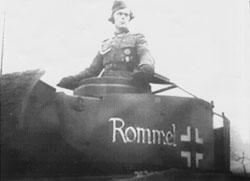 Volume
79
Volume
79
Newsreel 744 (7 December, 1944): Railroad workers: training apprentice engineers
in locomotive construction and operation; woman as stationmaster, Grossdeutschland
guard regiment musters in Berlin; Goebbels becomes honorary commander and speaks;
Brigadier General Lorenz gives Goebbels Grossdeutschland sleeve band. Captain
Schnaufer after receiving Diamonds decoration for victories as night-fighter
pilot. Lieutenant Brandi, a submariner. German Light and Heavy Cruisers in Courland
Lagoon; Germans Fight French Units in Vosges Mountains; Defensive Battles in
the Balkans; Hungary's Head of State Szálasy Visits Hitler; Blown-up
Waal River Dams Near Arnhem; Himmler Decorates Waffen-SS Soldiers; Defensive
Battles on the Western Front.
Click on the links below to view descriptions of other
films from the series
"Through Enemy Eyes"
The swift collapse of the Third Reich in the spring of 1945
brought, with the surrender, mountains of films and documents covering the entire
period of the Nazi regime. Perhaps no other period in history is as well documented.
Many of these films are now historical documents of a time when madness and
hate overran mankind. Some films made in those years do not reflect current
official views of Germany, its people, or other nations and should be used only
with extreme parental discretion and guidance. Almost 55 years have passed since
the terrible holocaust. The memories and the consequences are still with us
today. HOW...WHY... could such a system have arisen and flourished? How many
times have the questions been asked? How many answers have been offered? The
voices on these video tapes are the voices of history... perhaps those who listen
today can help answer the questions posed by these terrible years!
 Volume
80
Volume
80
Newsreel 747 (4 January 1945): Hitler Youth members celebrate solstice. Mountain
infantrymen in training ski down mountain. In Berlin, ice-skaters perform in
burnt-out Sports Palace. Southeastern Front: pilots, including Colonel Rudel,
fire on Soviet tanks from ground-attack planes; battles between Danube and Lake
Balaton. Germans launch Ardennes offensive (Battle of the Bulge): on morning
of December 16th, V-1s, rockets, and artillery launch attack; soldiers wait
to attack; Allied prisoners taken half an hour after attack begins; tanks, assault
guns, and German columns; American dead; tanks break through wire fence into
village; infantry and paratroopers fight Americans house-to-house and take many
prisoners; destroyed Sherman tanks and captured jeep; Sepp Dietrich; V-1 overhead;
allied equipment; supply columns; flak fires at American fighter-bombers; German
fighter planes; German villagers welcome soldiers; field Marshal Model; American
wounded and prisoners (black prisoners emphasized); German soldiers eat and
relax. 14 min. Newsreel 748 (11 January 1945): this newsreel begins with a separate,
untitled segment containing a public appeal different from other "public
service announcements" in its insistent directness urging people to donate
clothes and equipment to the Volkssturm and other soldiers: battlefield action;
people donating; Volkssturm and others being equipped. In munitions factory,
new Volksgrenadier soldiers sworn in : officer speaks and soldiers take oath
(both synchronous sound); armaments workers hand out weapons. Third large-scale
in counterattack; burning T-34; torpedo boats, including one firing. German
bases on Atlantic; greetings to homeland via voice radio and nurses prepare
Christmas display; soldiers in field receive Christmas mail; Allied artificial
harbors destroyed by wind and wave. Ardennes offensive (Battle of the bulge):
Model talks with soldier: German tanks advance: American dead and destroyed
American equipment in recaptured town; German reinforcements German flak and
fighters; tanks penetrate village. January 1st Luftwaffe attack on Allied and
planes on ground blown up; American fighters and bombers (including a Lightning)
shot down (film shot from German plane). 11 min. Newsreel 749 (189 January 1945):
One hundredth anniversary of Karl Benz's birthday: old cars; modern race cars;
military transport. Reich Railroad: makeshift huts used as ticket offices and
living quarters for railroad personnel; makeshift passenger cars. Civilians
contribute clothes and equipment for Volksgrenadier divisions and Volkssturm.
Transport convoy fights bombers with flak and enemy ships with artillery and
rockets. Southeastern Europe: in Hungary, German
 Volume
81
Volume
81
Newsreel 750 (25 January 1945): Public service announcement uses trick drawings
to urge people to save electricity by turning off unnecessary lights. Two soldier
amputees ski down a mountain. Volkssturm members receive clothing and equipment,
and practice with adhesive charges, Panzerfaust, Panzerschreck, and flamethrower.
In the Dutch combat area, Navy men blow up bridge by jumping out of speedboats
carrying explosive charges to target. In town near Western Front, life continues
underground: kitchens, archives, town administration, print shop, power plant,
newspaper, barber; miners changing shifts. Ardennes offensive (Battle of the
Bulge); German village recaptured: British and Gaullist prisoners; tanks, infantry,
and supply convoys advance; infantrymen in rear positions withstand Soviet air
attack; street fighting; ground-attack planes knock out Soviet tanks (pictures
taken from plane. 10 min. Newsreel 751 (10 February 1945): Seriously-wounded
soldiers return home by train as part of exchange. Western Front: artillery,
rockets, aerial battle, tanks, infantry, knocked-out Allied tanks. Eastern Front:
columns of westward-bound refugees; soviet prisoners; Volkssturm building barricades;
refugees leave by train, cared for by National socialist People's Welfare Organization;
Volkssturm gets close-combat anti-tank weapons; Goliath tanks and artillery
ammunition loaded for transport to front; tanks and supply trucks advance; in
Katowice, weapons are ready and soldiers with Panzerfausts take position; in
East Prussia, artillery and infantry; ground-attack planes; aerial-delivery
unit containing Panzerfausts attached to combat plane; transport glider loaded,
towed, and released; aerial delivery units thrown from transport plane; on the
coast of Courland, soldiers donate money to winter Relief organization and fight
snow. Southeastern Front: in Budapest, residents build barricades and German
and Hungarian troops fire flak at Soviet tanks; southwest of Budapest after
counterattack between lake Balaton and Budapest reaches Danube, German tank
formations and infantry and knocked-out Soviet assault guns; in Stuhlweissenburg
after recapture by Germans, troops welcomed by population; machine guns fire
at soviet cavalry patrol and artillery fires on Soviet positions. 10 min. Newsreel
752 (17 February 1945): Wool contributed by population is made into uniforms
and blankets for Wehrmacht and Volkssturm. western Front: in the Dutch combat
area, paratroopers travel across Rhine and take new positions while under aerial
attack; in the Eifel, infantry destroy allied reconnaissance vehicle; knocked-out
allied tanks; infantry fire from ruins of hatten. Eastern Front: infantrymen
and motorcycle messenger in snowstorm. Navy in East Prussia: men and equipment
loaded on ships; convoy en route; firing on Soviets near Vistula Lagoon. Breslau:
Volkssturm building barricades at city's edge; District Director Hanke visits
defensive installations and speaks with General Schoerner; engineers blow up
buildings. Area of Frankfurt on the Oder: Columns of refugees; Volksgrenadiers;
Volkssturm arrive by rail; planes take off; tanks and infantry advance; SS paratroopers
at Oder bridgehead; knocked-out Soviet tanks and Soviet dead; Oder village recaptured
from Soviets; Reich Labor Service flak against Soviet tanks; rockets. 10 min.
 Volume
82
Volume
82
Newsreel 753 (5 March 1945): German Ambassador in Stockholm congratulates Swedish
explorer Sven Hedin on his 80th birthday. Reich Labor Service Leader Hierl speaks
with Labor Service Women and decorates Labor Service officer. Colonel Rudel
interviewed in hospital (synchronous sound). In Berlin, Volkssturm and civilians
build defensive installations. Submarine with snorkel sinks ship. Western Front:
positions on the Rur (Roer); from the ruins of houses, mortars and other artillery
fire; near Juelich, infantry and paratroopers counterattack. First pictures
of soldiers after breaking out of Budapest to German lines. Silesia: infantry
march near Ratibor; Breslau commander with Reich Labor Service flak: in recaptured
villages, Soviet atrocities; blown-up Fuerstenberg bridge; signals auxiliary
woman recipient of Iron Cross. Frankfurt on the Oder area: Goebbels and Lieutenant
General Busse on the Oder; machine-gun units; infantry and artillery on railway
embankment; supply trains; tanks and infantry counterattack; Soviet dead; fleeing
Soviet tanks knocked out; destroyed T-34. 13 minutes. Newsreel 754 (16 March
1945): Police quash strike in US. Western Front: American prisoners; on Rhine,
artillery fires a factory; District Party Director Grohe speaks with officers;
marching Volksgrenadiers with Panzerfausts; paratroopers; anti-tank artillery
(pak). general Vlasov takes command of anti-Stalinist Russian units; Lieutenant
General Koestring. Fifth large defensive battle at Courland bridgehead: soviet
artillery; machine guns fire at advancing Soviets; wounded and civilians evacuated
over frozen lakes; cattle evacuated. Marienburg: destroyed buildings; soldiers
fire from ruins. On the Eastern Front, Otto Skorzeny speaks to his men (synchronous
sound) and decorates soldier who relates battlefield exploits (synchronous sound).
Soldiers in recaptured Guben fight street battles; T-34 tank blown up. On autobahn
near Dresden, Soviet prisoners, including commissar and woman. Near Goerlitz,
factory operating immediately behind front lines. Liberation of Lauban: infantry
and tanks; on March 6th, German march into city and Goebbels views assault-gun
unit; General Schoerner; Fuehrergrenadier unit; Hitler Youth has received Iron
Cross; Goebbels speaks to soldier; murdered German women and children. In Goerlitz,
Goebbels speaks (synchronous sound). Hitler visits eastern division command
post, speaks with officers, and is cheered by soldiers. 13 min. Newsreel 755
(22 March 1945): In Berlin, Captain Aghta and his bomb-disposal unit at work.
Civilians learn how to shoot Panzerfaust. In the Chancellery courtyard, Hitler,
accompanied by Axmann, greets 20 Iron Cross recipients from Hitler Youth (these
last film pictures of Hitler are often mistakenly dated April 20); several of
the boys relate battlefield accomplishments (synchronous sound). First Iron
Cross recipient in Volkssturm. Breslau: District Party Director Hanke at command
post; men and women build defensive installations; street battle. Koenigsberg:
commandant Lasch and district Party Director Koch at command post; Volkssturm
set up positions; firing from ruins; wounded in basement military hospital;
decorations awarded. navy: evacuates refugees from East and West Prussia; brings
supplies to Courland, firing at enemy coastal positions. Reinforcements advance
to Eastern Front. German women describe soviet rapes (synchronous sound); murdered
German civilians. Stetting bridgehead: infantry and Volkssturm on embankment;
knocked-out Stalin tank; flak in ground fighting; wounded assault-gun driver
fights on; soldiers decorated. 11 min.
Click on the links below to view descriptions of other
films from the series
"Through Enemy Eyes"